
Learning · Metacognition
Metacognitive Awareness Assessment
Do you know what you know? This assessment measures two skills that shape every decision: how well you watch your own thinking, and how closely your confidence matches your accuracy. It now includes the Calibration Check.
About five to ten minutes. Your results appear as soon as you finish.
Metacognitive Awareness1:05
What the metacognitive awareness assessment measures
Metacognition is thinking about your thinking. John Flavell named it in 1979: the ability to monitor, evaluate and direct your own thought processes. Gregory Schraw and Rayne Dennison built the first widely used measure of metacognitive awareness in adults (1994).
The assessment has two parts.
Thinking habits. How you plan, monitor and check your own thinking, and which traps you fall into: rumination, catastrophizing, mind-reading and all-or-nothing thinking. Racing, looping, worst-case thinking is one of the most common engines of stress, and it is hard to interrupt a pattern you have never named.
Calibration. You answer deliberately tricky questions and rate your confidence in each answer. The scoring compares the two. Researchers have studied calibration for decades, from weather forecasters to expert judgment (Brier, 1950; Lichtenstein, Fischhoff and Phillips, 1982). A well-known finding is that people with the least skill in an area tend to overestimate their performance the most (Kruger and Dunning, 1999).
This is not a trivia test. Your score depends on self-knowledge, not on getting the answers right.
What each result means
Your calibration result is a point on a map. Across the bottom runs underconfident to overconfident: whether your confidence runs lower or higher than your accuracy. Up the side runs a fuzzier to a sharper sense: how well your confidence tells your right answers from your wrong ones. A dashed line marks perfect calibration.
The Navigator
Little bias, high sensitivity. Your feeling of certainty is a reliable signal. When you feel sure, you usually are; when you hesitate, there is usually a reason.
The Underclaimer
Confidence below accuracy, with good sensitivity. Your judgment is sound, but doubt drowns the signal. You may defer to louder voices who know less.
The Charger
Confidence above accuracy, with low sensitivity. You commit quickly and feel sure whether you are right or wrong. Decisive, and exposed when the stakes are high.
The Scout
Little bias, lower sensitivity. Your average confidence is about right, but it does not yet separate the answers you know from the ones you are guessing. This is a common starting point, and it improves with practice.
Uncharted
Confidence above accuracy, with high sensitivity. A less common pattern: you can tell your strong answers from your weak ones, but you rate them all a little high.
Habits behind it
Three habits keep judgment honest. Seeing the other side is how well you consider an opposing view. Checking your own work is how often you go back over your reasoning. Checking before you are sure is whether you test a confident answer before acting on it, including bringing in someone who knows more (Leary et al., 2017).
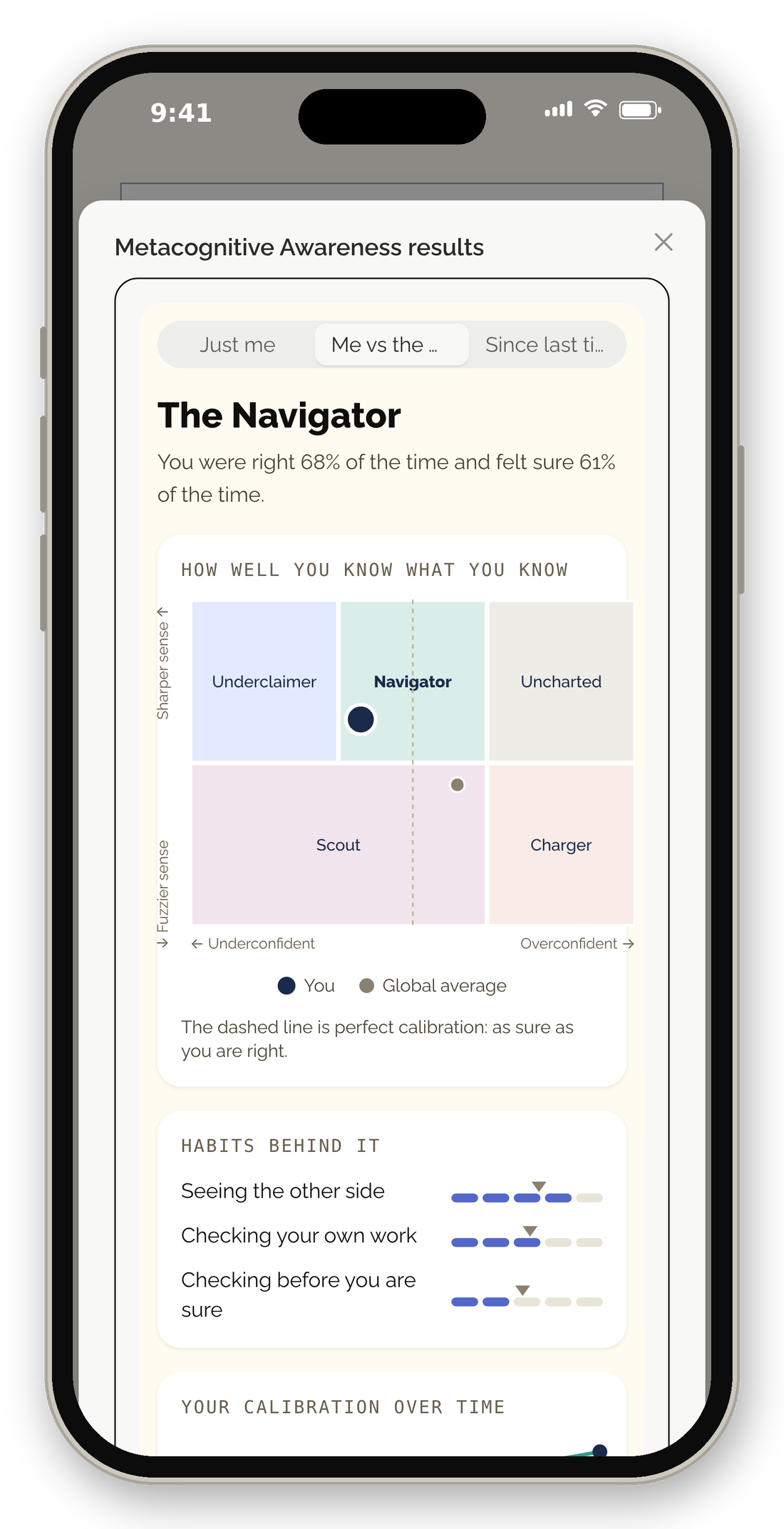
Reading a sample result
This person is a Navigator. They were right 68 percent of the time and felt sure 61 percent of the time: slightly underconfident, and close to well calibrated.
On the map, the dashed line is perfect calibration. Their marker sits just left of it, in the Navigator zone. The Me vs the world view adds the global average, a grey dot in the Scout zone: a fuzzier sense, and slightly overconfident. This person reads their own accuracy better than most.
“Habits behind it” shows seeing the other side, checking your own work, and checking before you are sure, each with the world average marked.
The screen shows sample data from the SPARKS app.
How SPARKS goes further
Most assessments ask how you see yourself. This one tests whether that self-view is accurate. That makes it a useful lens on every other result you have.
SPARKS Relational Intelligence reads it alongside the rest of your profile. A Charger with high Big Five extraversion will push a wrong answer persuasively in a meeting. An Underclaimer with a passive Communication Style will hold back a right one. Your Learning Styles result shows how you take in new information; this one shows whether you know when you have taken it in.
The thinking-habits part feeds the Reflection Journal, which helps you catch a thought spiral early and name the trap it is using. You can compare your result with groups of people like you, never with any individual.
Questions
Metacognitive awareness questions
What is metacognitive awareness?
The ability to monitor, evaluate and direct your own thinking. It includes knowing what you know, noticing when you are stuck in a thinking trap, and checking your reasoning before you act.
What is calibration?
How closely your confidence matches your accuracy. A well-calibrated person is right about 70 percent of the time when they feel 70 percent sure.
What happened to the Calibration Check?
It is now part of this assessment. The calibration questions, the profiles and the habits behind them all appear in your Metacognitive Awareness result.
Is this an intelligence test?
No. Your score depends on how well you judge your own answers, not on how many you get right.
Can calibration improve?
Yes. Research on forecasters shows that feedback on your confidence improves it (Tetlock and Gardner, 2015). The assessment repeats with fresh questions so you can see your progress.
How long does it take?
About five to ten minutes.
Related assessments
- Learning Styles: how you take in new information
- Big Five: the traits that shape how you express confidence
- Leadership Across Contexts: how you step up when a decision has to be made
From High on Healthy
Conversations on attention, focus and thinking from the High on Healthy podcast.
- AI, Cybersecurity, and Protecting the Human Mind with Eva BennIn cyber security the target has shifted from computers to the human mind, because AI can engage our emotions and nervous system the way another person does.
- Navigating Political Division & Personal Agency with Adam W. BarneyMany people treat an election as a verdict on who they are, so every political loss feels like a threat to their safety and belonging.
- Who Owns Your Attention? Gloria Mark on Rethinking Focus in the Digital AgeWe have not lost our capacity for attention, but our digital environment makes it harder to use.
Sources
The Metacognitive Awareness assessment in SPARKS draws on this research. See every reference.
- Flavell, J. H. (1979). Metacognition and cognitive monitoring: A new area of cognitive-developmental inquiry. American Psychologist, 34(10), 906-911.
- Schraw, G., and Dennison, R. S. (1994). Assessing metacognitive awareness. Contemporary Educational Psychology, 19(4), 460-475.
- Lichtenstein, S., Fischhoff, B., and Phillips, L. D. (1982). Calibration of probabilities: The state of the art to 1980. In D. Kahneman, P. Slovic, and A. Tversky (Eds.), Judgment Under Uncertainty: Heuristics and Biases (pp. 306-334). Cambridge University Press.
- Kruger, J., and Dunning, D. (1999). Unskilled and unaware of it: How difficulties in recognizing one's own incompetence lead to inflated self-assessments. Journal of Personality and Social Psychology, 77(6), 1121-1134.
- Leary, M. R., Diebels, K. J., Davisson, E. K., et al. (2017). Cognitive and interpersonal features of intellectual humility. Personality and Social Psychology Bulletin, 43(6), 793-813.
- Tetlock, P. E., and Gardner, D. (2015). Superforecasting: The Art and Science of Prediction. Crown.
Your answers stay yours. No one sees your answers, and your results stay private unless you choose to share them. If your organization offers SPARKS, it sees only groups of 30 people or more, never you.