
Relationships · Attachment
Attachment Style Quiz
Attachment theory, built on more than fifty years of research, describes the bonding pattern you learned in your earliest relationships. That template shapes how you handle closeness, distance and uncertainty as an adult, most of all under stress. This assessment shows which pattern you lean on, and what it asks of you.
About five to ten minutes. Your results appear as soon as you finish.
Attachment Style1:08
What the attachment style quiz measures
Attachment theory began with John Bowlby, who described the bond between infants and caregivers as a survival system (Bowlby, 1969). Mary Ainsworth then showed that children fall into distinct patterns of seeking comfort (Ainsworth et al., 1978). In 1987, Cindy Hazan and Phillip Shaver showed that the same patterns appear in adult romantic relationships.
Researchers now measure adult attachment on two dimensions. Attachment anxiety is how much you worry about rejection, and whether people will be there for you. Attachment avoidance is how uncomfortable you are with closeness and with depending on others. Kim Bartholomew and Leonard Horowitz (1991) showed that the two dimensions together give four styles. Questionnaires built on these two dimensions, such as the ECR-R (Fraley, Waller and Brennan, 2000), are the standard way to measure them in adults.
The SPARKS assessment follows that model. You rate statements about how you think, feel and act in close relationships. Your result places you on a map of the two dimensions, names your primary style and its strength, and lists the styles that can show up under stress, so you see the mix, not only a label.
Why understanding your own attachment style matters
When a relationship feels hard, it is natural to look at the other person first. Research points the other way. A review of 132 studies found that your own attachment pattern is more closely linked to how satisfied you feel in a relationship than your partner’s pattern is.
That is good news. Your own pattern is the part you can see, understand and work with. Knowing your style helps you notice the moments that unsettle you, explain what you need before tension builds, and choose a different response when an old habit kicks in.
What each attachment style means
Secure
Low anxiety and low avoidance. You can ask for what you need, tolerate some distance, and repair after a conflict without assuming the relationship is over. Secure does not mean conflict-free. It means a disagreement does not feel like a threat to the bond itself.
Anxious (anxious-preoccupied)
High anxiety and low avoidance. Closeness feels good but never quite certain. A slow reply can feel like a verdict, and you may chase reassurance harder when you sense a gap. Under stress, the pull is toward more contact, more checking and more explaining.
Avoidant (dismissive-avoidant)
Low anxiety and high avoidance. You value independence and pull back when things get close or emotional. The withdrawal is self-protection, not indifference. Under stress, the pull is toward handling it alone and going quiet.
Fearful-avoidant (disorganized)
High anxiety and high avoidance. You want closeness and fear it at the same time, which can feel like moving toward someone and away from them in the same week. Under stress, both pulls fire at once, which is why this pattern can feel confusing from the inside.
Most people carry some of each. The useful question is not “which one am I?” but “which one takes over when I am under pressure, and with whom?”
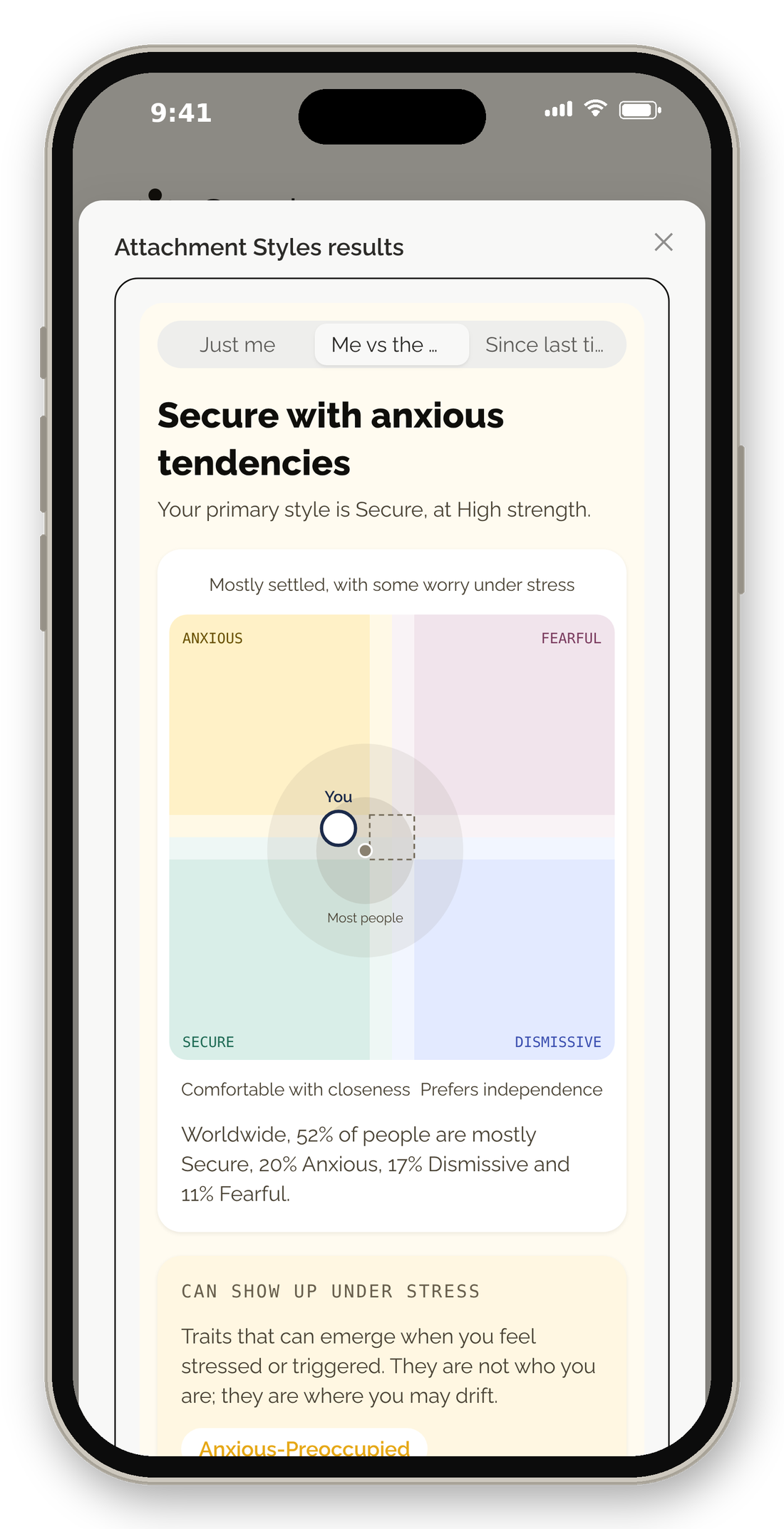
Reading a sample result
This person’s result is “Secure with anxious tendencies”. Their primary style is Secure, at High strength.
The map shows why. Across the bottom is avoidance, how comfortable you are with closeness. Up the side is anxiety, how much you worry about rejection. The “You” marker sits in the secure zone, close to the line with the anxious zone: mostly settled, with some worry under stress.
The Me vs the world view adds the shaded circle where most people sit, and how common each style is among SPARKS users. Below the map, the styles that can show up under stress are listed: here, Anxious-Preoccupied and Fearful-Avoidant.
The screen shows sample data from the SPARKS app.
How SPARKS goes further
An attachment result on its own tells you how you bond. It cannot tell you how that pattern sounds when you are upset, or what you do in a disagreement. Every assessment answers one narrow question well and is silent on the questions next to it.
SPARKS Relational Intelligence puts your answers side by side. Your attachment style is combined with your Communication Style and Conflict Style to build your Relationship Lens. An anxious attachment with an assertive communication style reads very differently from an anxious attachment with a passive one. The first asks directly for reassurance; the second waits, hopes and keeps score. The same label, two different relationships.
Your result also shapes the rest of the platform. The Communication Coach uses it when it helps you word a hard message or read one you received. The Reflection Journal uses it to explain why a moment hit harder than it should have. You can also compare your result with groups of people like you, never with any individual.
Attachment Style is one of the Core Five, with the Big Five, the Enneagram, Values and Beliefs, and Communication Style. Complete all five and you receive your Actionable Insights Report, one picture of how you think, feel and connect. Finding Your Prism explains which to take first.
Take the attachment style quiz
Attachment at work, not only in love
Attachment research began with parents and children, then moved to adult partners. The same system runs in every relationship where you depend on someone. It shows up in how you read a manager’s two-line email, how you react when a colleague goes quiet, and whether you ask for help early or wait until it is too late.
Questions
Attachment style questions
What are the four attachment styles?
Secure, anxious (anxious-preoccupied), avoidant (dismissive-avoidant) and fearful-avoidant (disorganized). They come from two dimensions: how much you worry about rejection, and how uncomfortable you are with closeness.
Can my attachment style change?
Yes. Research on earned security shows that people move toward a secure style through stable relationships, therapy and deliberate practice. Your result describes where you are now, not where you have to stay.
Is my attachment style the same with everyone?
Not always. Many people are more secure with friends than with partners, or more anxious with a manager than with a peer. Your result describes your general tendency, and the Relationship Lens shows how it combines with your other styles.
Is anxious attachment bad?
No style is bad. Each one is a strategy you learned for staying close to people. Anxious attachment often comes with real attunement to others. The cost is the worry, and knowing the pattern is how you lower it.
Is this a diagnosis?
No. Attachment style is a description of relationship patterns, not a clinical condition. If a result raises something painful, a qualified therapist is the right next step.
How long does the attachment style quiz take?
About five to ten minutes. Your result appears as soon as you finish, and you can repeat the quiz later to see how it moves.
Related assessments
- Love Languages: which expressions of care actually reach you
- Conflict Style: what you do when a disagreement starts
- Communication Style: how your words land when you are under pressure
From High on Healthy
Conversations on attachment and relationships from the High on Healthy podcast.
- Navigating AI’s Impact on Mental Health and RelationshipsAn AI can only reflect back what you report, so if you describe yourself as emotionally available, it has no way to see what you leave out.
- How Psychedelic-Assisted Therapy Transforms RelationshipsEmpathy starts with a safe enough environment, because lowering your defenses only makes sense when what you reveal will not be used against you.
- Healing the Inner Child: Moving Beyond Patterns to WholenessChildhood pain does not have to be extreme abuse, because a parent who was often absent can teach a child to believe they cannot depend on others.
All Attachment and Relationships →
Sources
The Attachment Style assessment in SPARKS draws on this research. See every reference.
- Bowlby, J. (1982). Attachment and Loss: Vol. 1. Attachment (2nd ed.). Basic Books. (Original work published 1969)
- Ainsworth, M. D. S., Blehar, M. C., Waters, E., and Wall, S. (1978). Patterns of Attachment. Lawrence Erlbaum.
- Hazan, C., and Shaver, P. (1987). Romantic love conceptualized as an attachment process. Journal of Personality and Social Psychology, 52(3), 511-524.
- Bartholomew, K., and Horowitz, L. M. (1991). Attachment styles among young adults: A test of a four-category model. Journal of Personality and Social Psychology, 61(2), 226-244.
- Fraley, R. C., Waller, N. G., and Brennan, K. A. (2000). An item response theory analysis of self-report measures of adult attachment. Journal of Personality and Social Psychology, 78(2), 350-365.
Your answers stay yours. No one sees your answers, and your results stay private unless you choose to share them. If your organization offers SPARKS, it sees only groups of 30 people or more, never you.