
Relationships · Love Languages
Love Language Quiz
If you feel most loved when someone puts it into words, while your partner shows it by quietly fixing things, you will both keep offering care that does not land. This quiz names the signals that register for you, and the ones you keep sending that may not register for them.
Thirty quick choices, about five minutes. Your results appear as soon as you finish.
Love Languages1:04
What the love language quiz measures
The five love languages come from Gary Chapman’s 1992 book, written from his work as a marriage counselor. Chapman noticed that partners often express care in one way and hope to receive it in another. He grouped the ways into five languages.
Researchers have since tested the idea. Egbert and Polk (2006) found that the five languages map onto established ways couples maintain their relationships. Bunt and Hazelwood (2017) found that couples with matching love languages were not more satisfied; the effort partners put into their relationship mattered more. A 2024 review in Current Directions in Psychological Science concluded that people value all five, and that the framework works best as a prompt for conversation, not a fixed category (Impett, Park and Muise, 2024).
We built the SPARKS assessment with that research in mind. It uses thirty forced-choice pairs. Each pair asks which of two good things means more to you, so the answer that flatters you does not stand out. Your result is a ranking across all five languages, not a single label.
What each love language means
Words of affirmation
Care you hear. Praise, encouragement, “I’m proud of you”, a note left on the counter. If this ranks high, silence can feel like distance even when everything else is fine.
Quality time
Care you feel through attention. Undivided time, a walk without phones, a conversation that is not about logistics. If this ranks high, a distracted evening together can feel lonelier than an evening apart.
Physical touch
Care you feel through closeness. A hand on the shoulder, a hug at the door, sitting close. If this ranks high, physical distance during a conflict can feel like a much bigger signal than it was meant to be.
Acts of service
Care you see in effort. Fixing the car, handling the appointment, making the coffee before you ask. If this ranks high, “I love you” with no follow-through may not register at all.
Receiving gifts
Care you can hold. Not about price; about the evidence that someone thought of you while you were apart. If this ranks high, a forgotten occasion can hurt more than others expect.
Most people send care in their own language. The useful part of your result is the gap between what you give and what reaches the people closest to you.
Reading a sample result
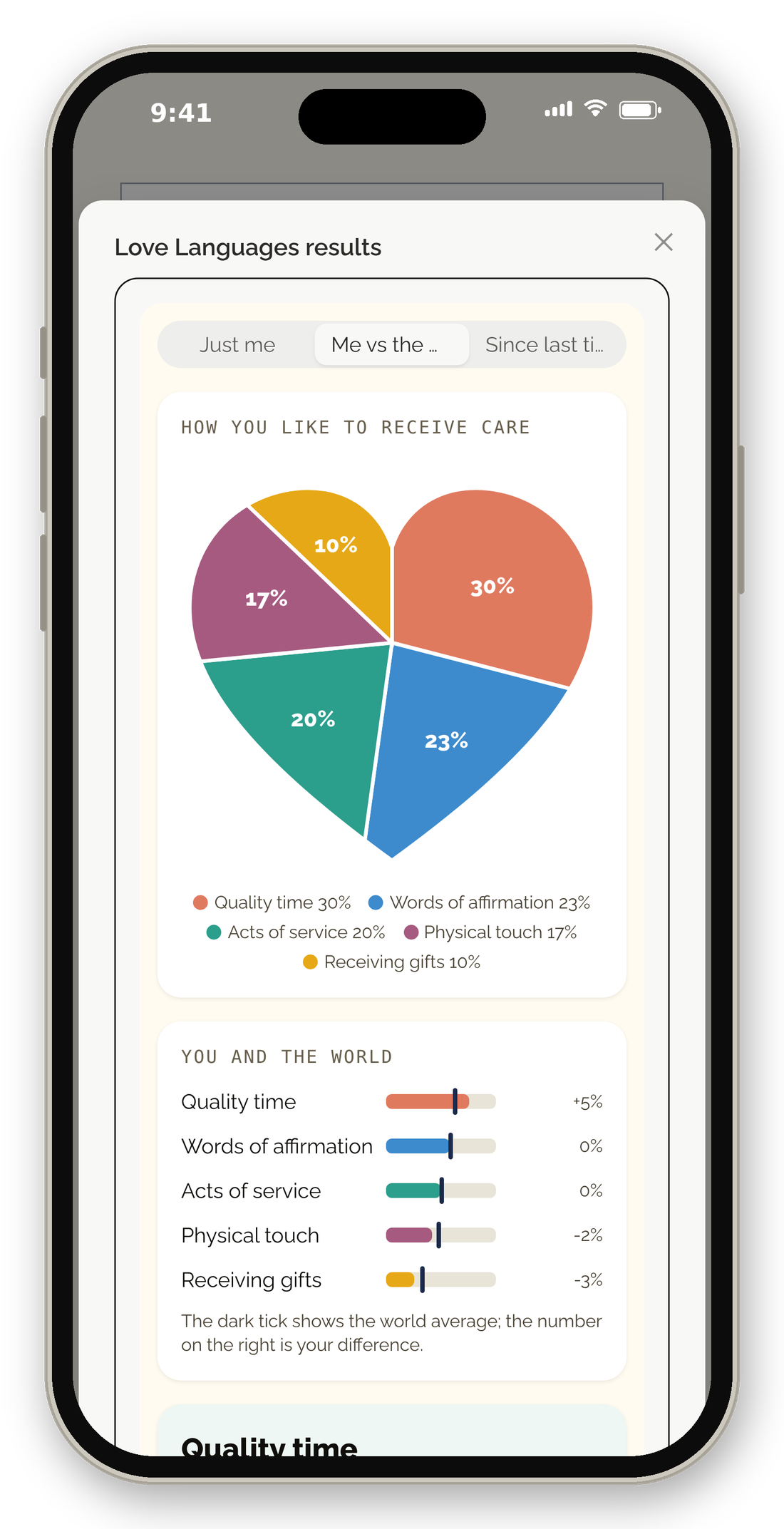
This person’s ranking: quality time 30 percent, words of affirmation 23 percent, acts of service 20 percent, physical touch 17 percent and receiving gifts 10 percent.
The Me vs the world view adds “You and the world”: a dark tick for the world average on each bar, and the difference on the right. Quality time is 5 points above average; physical touch and gifts are slightly below.
The spread is narrower than most people expect. That matches the research: people value all five, so the ranking is a starting point for a conversation, not a fixed type.
The screen shows sample data from the SPARKS app.
How SPARKS goes further
A love language result tells you which expressions of care reach you. It does not tell you why distance feels the way it does, or how you ask for what you need. Those are separate questions, answered by separate assessments.
SPARKS Relational Intelligence reads them together. Attachment Style explains why closeness and distance feel the way they do. Communication Style explains how your words land. Love Languages explains which care you actually feel. An anxious attachment with quality time at the top is a person for whom a phone-heavy evening is not a small thing. An assertive communicator with the same profile will say so; a passive one will go quiet and hope it is noticed.
Your result shapes your relationship insights and the guidance the Communication Coach gives on messages to the people closest to you. You can also compare your ranking with groups of people like you, never with any individual.
Questions
Love language questions
What are the 5 love languages?
Words of affirmation, quality time, physical touch, acts of service and receiving gifts. The framework comes from Gary Chapman’s 1992 book.
Is the love languages idea backed by research?
Partly. Studies support the five as real ways people express care. A 2024 review found that most people value all five, so your result is best read as a ranking and a conversation starter, not a fixed type.
Do partners need the same love language?
No. One study found that matching love languages did not predict satisfaction; effort did. Knowing both rankings makes that effort easier to aim.
Can my love language change?
Yes. What you need most can shift with life stage, stress and the relationship you are in. Retake the quiz when something big changes.
Does this only apply to romantic relationships?
No. The same languages apply to friends, family and colleagues. A thank-you note and a manager who gives you uninterrupted time are both love languages at work.
How long does the love language quiz take?
About five minutes: thirty quick choices between two options.
Related assessments
- Attachment Styles: why closeness and distance feel the way they do
- Communication Style: how you ask for the care you need
- Conflict Style: what happens when care goes missing and tension builds
From High on Healthy
Conversations on attachment and relationships from the High on Healthy podcast.
- Navigating AI’s Impact on Mental Health and RelationshipsAn AI can only reflect back what you report, so if you describe yourself as emotionally available, it has no way to see what you leave out.
- How Psychedelic-Assisted Therapy Transforms RelationshipsEmpathy starts with a safe enough environment, because lowering your defenses only makes sense when what you reveal will not be used against you.
- Healing the Inner Child: Moving Beyond Patterns to WholenessChildhood pain does not have to be extreme abuse, because a parent who was often absent can teach a child to believe they cannot depend on others.
All Attachment and Relationships →
Sources
The Love Languages assessment in SPARKS draws on this research. See every reference.
- Chapman, G. (1992). The Five Love Languages: How to Express Heartfelt Commitment to Your Mate. Northfield Publishing.
- Egbert, N., and Polk, D. (2006). Speaking the language of relational maintenance: A validity test of Chapman's (1992) Five Love Languages. Communication Research Reports, 23(1), 19-26.
- Bunt, S., and Hazelwood, Z. J. (2017). Walking the walk, talking the talk: Love languages, self-regulation, and relationship satisfaction. Personal Relationships, 24(2), 280-290.
- Impett, E. A., Park, H. G., and Muise, A. (2024). Popular psychology through a scientific lens: Evaluating love languages from a relationship science perspective. Current Directions in Psychological Science, 33(2), 87-92.
Your answers stay yours. No one sees your answers, and your results stay private unless you choose to share them. If your organization offers SPARKS, it sees only groups of 30 people or more, never you.