
Learning · Learning Styles
Learning Style Test
How do you take in new material best: by listening, reading, watching, discussing or doing? This assessment maps your learning preferences, along with your preferred pace, session length, and appetite for structure versus exploration.
About five to ten minutes. Your results appear as soon as you finish.
Learning Style1:02
What the learning style test measures
The assessment draws on two of the best-known learning models. David Kolb’s experiential learning theory describes a cycle of concrete experience, reflection, abstract thinking and active experiment, and the place in that cycle where each person prefers to start (Kolb, 1984; Kolb and Kolb, 2005). Richard Felder and Linda Silverman described preferences on four scales: active or reflective, sensing or intuitive, visual or verbal, and sequential or global (Felder and Silverman, 1988). Bernice McCarthy’s 4MAT system turned Kolb’s cycle into a teaching sequence (1987).
We are careful about what a learning style result means. A major review found little evidence that teaching people in their preferred style, on its own, improves what they learn (Pashler et al., 2008). Preferences are real; the idea that each person can only learn one way is not. So SPARKS uses your result for what the evidence supports: knowing how you like to start, what conditions help you stay with something, and which habits to add when the material arrives in a form you would not choose.
What your learning style result means
Where you start in the learning cycle
Some people want to try it first, some want to watch and think, some want the theory, and some want to test it on a real problem. Knowing your starting point explains why some courses felt natural and others felt backward.
Active or reflective
Active learners process by doing and discussing. Reflective learners process by thinking it through alone first.
Sensing or intuitive
Sensing learners prefer facts, examples and proven methods. Intuitive learners prefer concepts, patterns and possibilities.
Visual or verbal
Visual learners hold on to diagrams, maps and pictures. Verbal learners hold on to written and spoken explanations.
Sequential or global
Sequential learners build step by step. Global learners need to see the whole landscape before the details make sense.
Pace, session length and structure
Short daily touches or deeper weekly dives; a clear plan or room to explore. These are the conditions that decide whether you finish what you start.
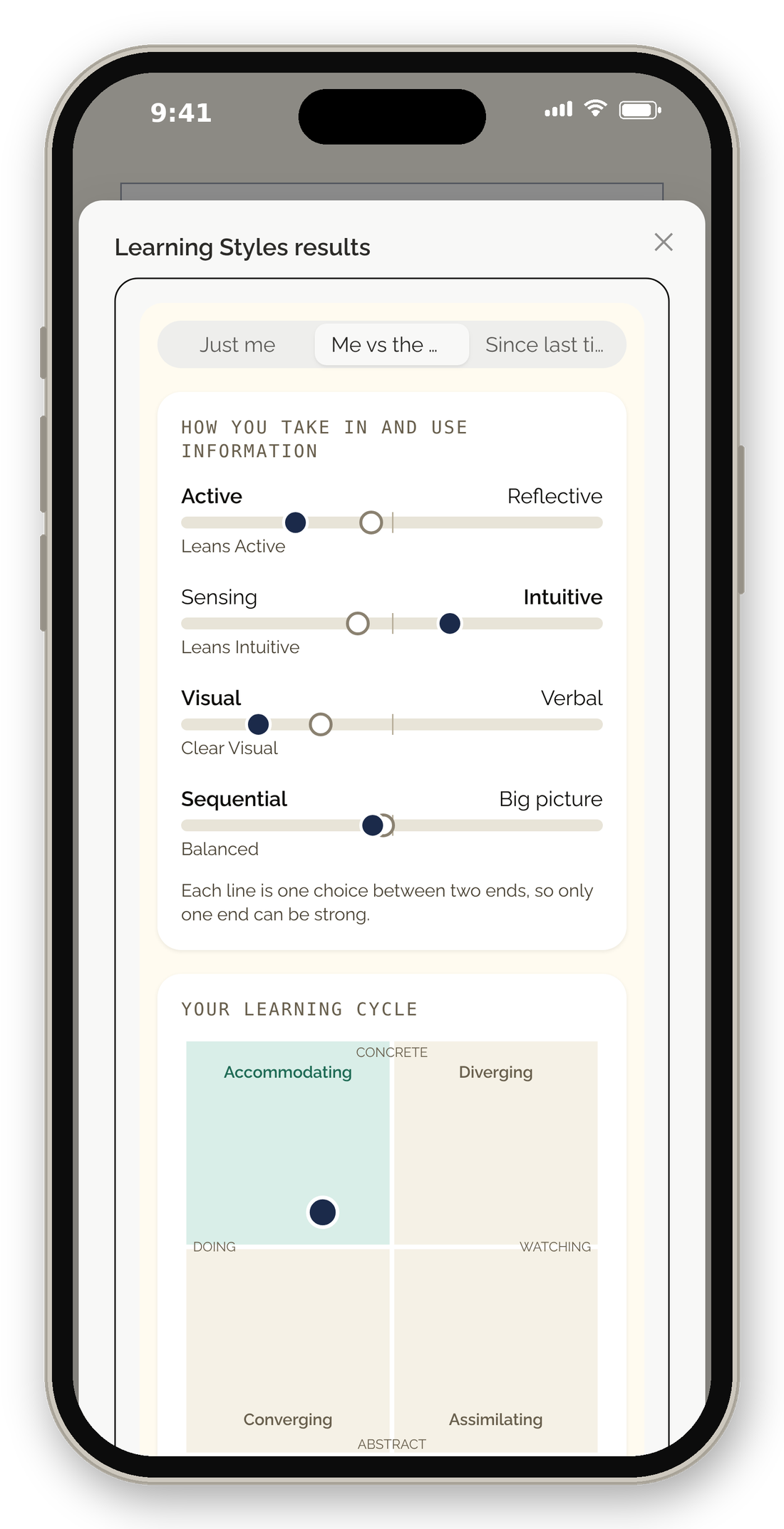
Reading a sample result
The four sliders are the Felder-Silverman scales. This person leans active, leans intuitive, is clearly visual, and is balanced between sequential and big picture. In the Me vs the world view, the open circle on each line is the world average, so you can see where you differ from most people.
The learning cycle below places them on Kolb’s model: in the Accommodating quadrant, where people learn by doing and by concrete experience. They want to try something before they read about it.
The screen shows sample data from the SPARKS app.
How SPARKS goes further
A learning style result on its own describes a preference. SPARKS Relational Intelligence reads it with your Big Five scores and your Metacognitive Awareness, which is how the sample report above arrives at advice about planners and stress. Learning Styles shows how you take in new information; Metacognitive Awareness shows whether you know when you have taken it in.
Your result also shapes your SPARKS experience: whether content leads with recorded or written material, short daily touches or deeper weekly dives, guided exercises or open reflection. You can compare your result with groups of people like you, never with any individual.
You may also stop blaming yourself for the courses, books and advice that never stuck. Often the material arrived in a form that fought how you like to learn, at a pace that did not suit you.
Questions
Learning style questions
What are learning styles?
Learning styles describe how a person prefers to take in and work with new material: by doing or reflecting, through facts or concepts, visually or verbally, step by step or big picture first.
Are learning styles scientifically proven?
Learning preferences are real and measurable. What research does not support is the idea that people can only learn in their preferred style. SPARKS uses your result to find good conditions and starting points, not to limit how you learn.
What is the Kolb learning style?
David Kolb described learning as a cycle of experience, reflection, thinking and experimenting. Your Kolb style is the part of the cycle where you prefer to start.
What is the Felder-Silverman model?
A model with four scales: active or reflective, sensing or intuitive, visual or verbal, and sequential or global. It was first developed for engineering education.
How long does the learning style test take?
About five to ten minutes.
Related assessments
- Metacognitive Awareness: whether you know when you have learned something
- Big Five: the traits that shape how you study
- Communication Style: how you take part when learning with others
From High on Healthy
Conversations on attention, focus and learning from the High on Healthy podcast.
- AI, Cybersecurity, and Protecting the Human Mind with Eva BennIn cyber security the target has shifted from computers to the human mind, because AI can engage our emotions and nervous system the way another person does.
- Navigating Political Division & Personal Agency with Adam W. BarneyMany people treat an election as a verdict on who they are, so every political loss feels like a threat to their safety and belonging.
- Who Owns Your Attention? Gloria Mark on Rethinking Focus in the Digital AgeWe have not lost our capacity for attention, but our digital environment makes it harder to use.
Sources
The Learning Styles assessment in SPARKS draws on this research. See every reference.
- Kolb, D. A. (1984). Experiential Learning: Experience as the Source of Learning and Development. Prentice Hall.
- Kolb, A. Y., and Kolb, D. A. (2005). Learning styles and learning spaces: Enhancing experiential learning in higher education. Academy of Management Learning and Education, 4(2), 193-212.
- Felder, R. M., and Silverman, L. K. (1988). Learning and teaching styles in engineering education. Engineering Education, 78(7), 674-681.
- McCarthy, B. (1987). The 4MAT System: Teaching to Learning Styles with Right/Left Mode Techniques. EXCEL.
- Pashler, H., McDaniel, M., Rohrer, D., and Bjork, R. (2008). Learning styles: Concepts and evidence. Psychological Science in the Public Interest, 9(3), 105-119.
Your answers stay yours. No one sees your answers, and your results stay private unless you choose to share them. If your organization offers SPARKS, it sees only groups of 30 people or more, never you.