
Personality · 16 Types
16 Personality Types Test
Are you energized by people or by time alone? Do you trust details or patterns, logic or values, plans or options? Four preferences, sixteen combinations. This Myers-Briggs style assessment gives you a shorthand for differences that cause years of friction.
About twenty minutes. Your results appear as soon as you finish.
16 Types1:05
What the 16 personality types test measures
The sixteen types come from Carl Jung’s theory of psychological types (Jung, 1921). Isabel Briggs Myers and Katharine Briggs turned Jung’s ideas into four pairs of preferences, and the combinations give sixteen four-letter types such as ENFP or ISTJ. The SPARKS assessment is a Myers-Briggs style assessment built on the same four preferences. It is not the official Myers-Briggs Type Indicator.
Type models are popular because they are easy to remember and easy to talk about. Researchers have pointed out a limit: people do not split neatly into two groups on each preference; most sit somewhere in the middle. McCrae and Costa (1989) found that four of the preferences line up closely with four of the Big Five traits. That is why SPARKS shows you how clear each preference is, not only the letter, and reads your type next to your Big Five scores.
What each preference means
Extraversion (E) or Introversion (I)
Where your energy comes from. Extraverts recharge with people and activity, and think out loud. Introverts recharge alone, and think before they speak. Most open-plan offices are designed for one and exhaust the other.
Sensing (S) or Intuition (N)
What information you trust. Sensing types trust concrete facts and experience. Intuitive types trust patterns, possibilities and the big picture. A Sensing manager and an Intuitive employee can read the same plan and see two different documents.
Thinking (T) or Feeling (F)
How you decide. Thinking types weigh logic and consistency first. Feeling types weigh values and the effect on people first. Both care about the other side; the question is which one goes first under time pressure.
Judging (J) or Perceiving (P)
How you handle structure. Judging types want a decision and a plan. Perceiving types want to keep options open as long as possible. Many arguments about deadlines are really this preference showing.
Your four letters name your type. The percentages tell you how strong each preference is, and a score near the middle means you move easily between both sides.
Reading a sample result
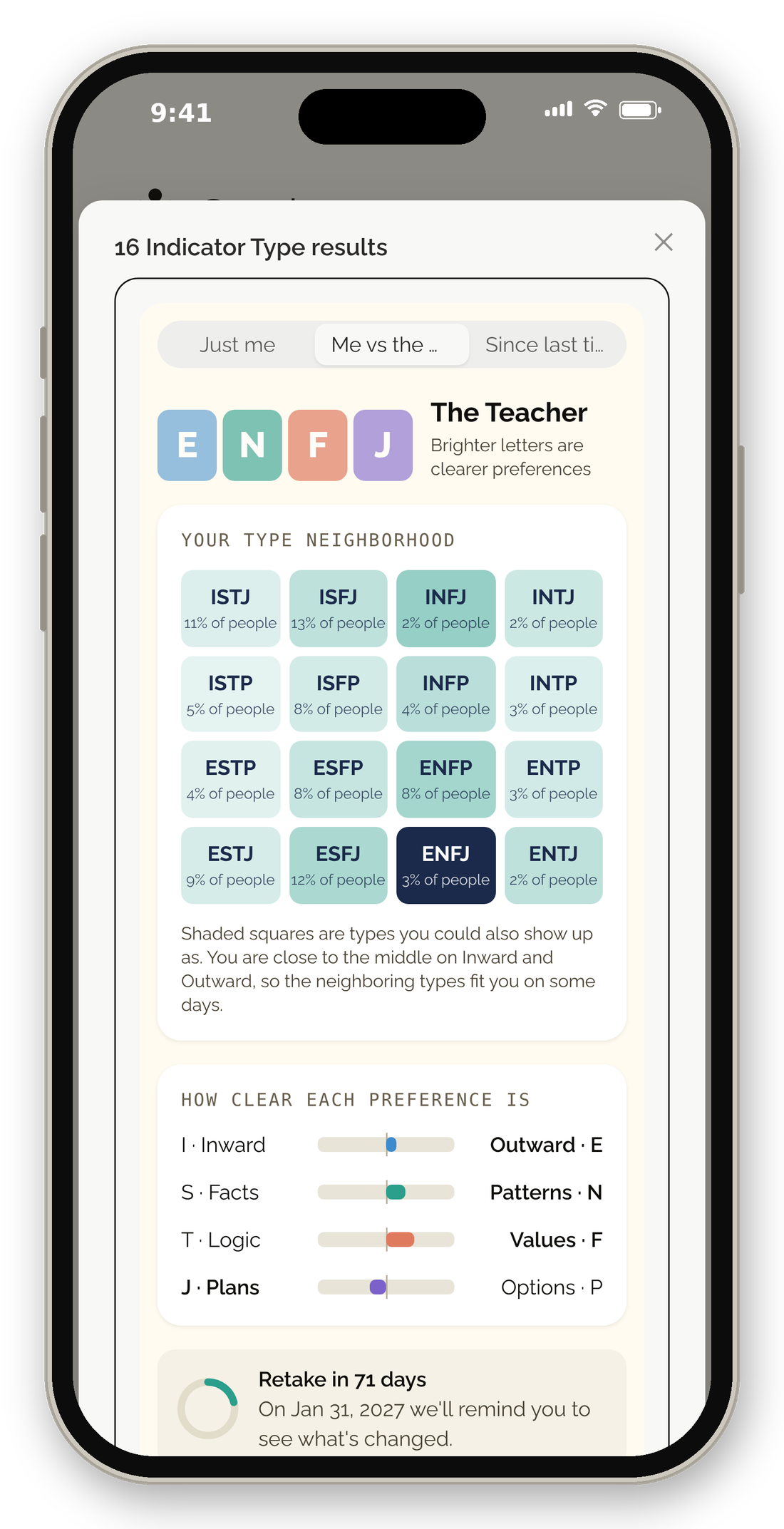
This person’s type is ENFJ, the Teacher. Brighter letters mean clearer preferences.
The Me vs the world view turns the type neighborhood into a map of how common each type is among SPARKS users. The shaded squares are types this person could also show up as; they are close to the middle on Inward and Outward, the app’s plain-language names for introversion and extraversion.
The bars under “How clear each preference is” show the strength of each preference, the nuance four letters alone cannot carry.
The screen shows sample data from the SPARKS app.
How SPARKS goes further
A type gives you a useful shorthand. It does not tell you how intensely you react to stress, what motivates you underneath, or how you behave in a disagreement.
SPARKS Relational Intelligence combines your type with your other results. Your preferences sit next to your Big Five scores, which add the trait the type model leaves out: emotional reactivity. An ENFP with low neuroticism and an ENFP with high neuroticism handle a bad week very differently. Your Enneagram type adds the motivation; your Conflict Style adds what you actually do when things get tense.
The combined picture feeds the reports, the Communication Coach and the Reflection Journal. You can compare your result with groups of people like you, never with any individual.
Questions
16 personality types questions
What are the 16 personality types?
The combinations of four preferences: Extraversion or Introversion, Sensing or Intuition, Thinking or Feeling, and Judging or Perceiving. Each type is written as four letters, such as INTJ or ESFP.
Is this the official Myers-Briggs Type Indicator?
No. It is a Myers-Briggs style assessment built on the same four preferences. The official instrument belongs to its publisher.
How is this different from the Big Five?
Type models sort you into categories; the Big Five scores you on a spectrum. Research shows four of the preferences line up with four Big Five traits. SPARKS shows how clear each preference is and reads your type next to your Big Five scores.
Why is my type different from last time?
If a preference is close to 50 percent, small changes in how you answer can flip the letter. How clear the preference is tells you more than the letter, which is why SPARKS shows it.
How long does the 16 types test take?
About twenty minutes.
Related assessments
- Big Five: the trait scores behind your type, including emotional reactivity
- Enneagram: the motivation underneath your preferences
- Social Styles: how others experience your preferences at work
From High on Healthy
Conversations on personality and self-awareness from the High on Healthy podcast.
- Finding Authenticity in a Hyper-Visible World with Dr. Joshua EstrinAuthenticity does not mean being one fixed self, because a person can show different versions of themselves on different platforms and still be honest in each one.
- Redefining Self-Improvement and Healing with Samantha DeCaroSelf-improvement messages in our culture often focus on appearance, which is a goal no one can ever finish reaching.
- Unlocking Unconscious Memory: Shale Maulana on Trauma, Dreams, and RegulationThe conscious mind works like a flashlight in a warehouse, so it can only light a small part of what a person carries from lived experience.
All Personality and Self-Awareness →
Sources
The 16 Types assessment in SPARKS draws on this research. See every reference.
- Jung, C. G. (1971). Psychological Types (Collected Works of C. G. Jung, Vol. 6). Princeton University Press. (Original work published 1921)
- Myers, I. B., McCaulley, M. H., Quenk, N. L., and Hammer, A. L. (1998). MBTI Manual: A Guide to the Development and Use of the Myers-Briggs Type Indicator (3rd ed.). Consulting Psychologists Press.
- McCrae, R. R., and Costa, P. T., Jr. (1989). Reinterpreting the Myers-Briggs Type Indicator from the perspective of the five-factor model of personality. Journal of Personality, 57(1), 17-40.
Your answers stay yours. No one sees your answers, and your results stay private unless you choose to share them. If your organization offers SPARKS, it sees only groups of 30 people or more, never you.