
Personality · Enneagram
Enneagram Test: Your Type, and Your Type Under Stress
Most Enneagram tests stop at your type. That is the top-level insight, and it is useful. What matters more is how you show up under stress, why, and how that shift appears in the way you talk and argue. That is the part SPARKS brings to the surface.
About ten minutes. Your results appear as soon as you finish.
The Enneagram1:07
What the Enneagram test measures
The Enneagram describes nine personality types. Each type is organized around a core motivation: what you are trying to get, and what you are trying to avoid. Where the Big Five describes how you behave, the Enneagram asks why. The modern system was shaped by Oscar Ichazo and Claudio Naranjo, and set out for a wide audience by Don Riso and Russ Hudson (1999).
The research base is younger than the Big Five’s. A systematic review in the Journal of Clinical Psychology found reasonable evidence for the reliability of Enneagram measures, with more research needed on validity (Hook et al., 2021). We treat the Enneagram as a strong language for motivation, and we pair it with the Big Five, which carries the stronger evidence.
The SPARKS assessment scores you on all nine types. You see your dominant type and its wing, your score on every type, and where you move under stress and in growth, so you see the whole shape, not one number.
What each Enneagram type means
Each type below has a core motivation, and a typical shift under stress. In Enneagram teaching, a type under pressure takes on the less healthy traits of another type, called its stress point (Riso and Hudson, 1999).
Type 1, the Reformer
Driven to be good and to get things right. Under stress, Ones can move toward Four: moody, resentful and convinced no one else holds the same standard.
Type 2, the Helper
Driven to be loved and needed. Under stress, Twos can move toward Eight: the helper who feels unappreciated becomes blunt, controlling and keeps a ledger.
Type 3, the Achiever
Driven to succeed and to be seen as valuable. Under stress, Threes can move toward Nine: disengaged and numb, going through the motions.
Type 4, the Individualist
Driven to find and express an authentic self. Under stress, Fours can move toward Two: clinging, and seeking reassurance that they matter.
Type 5, the Investigator
Driven to understand and to feel competent. Under stress, Fives can move toward Seven: scattered and restless, jumping between distractions instead of thinking.
Type 6, the Loyalist
Driven by security and support. Under stress, Sixes can move toward Three: overworking, image-conscious and competitive to prove their worth.
Type 7, the Enthusiast
Driven by freedom and new experience. Under stress, Sevens can move toward One: critical, perfectionistic and impatient with everyone.
Type 8, the Challenger
Driven to be strong and in control. Under stress, Eights can move toward Five: withdrawn, secretive and guarded.
Type 9, the Peacemaker
Driven by inner and outer peace. Under stress, Nines can move toward Six: anxious, suspicious and reactive.
Enneagram teaching also describes a growth point for each type, the healthier direction a type moves in when it feels secure. Knowing both tells you what pressure does to you, and what helps you recover.
Reading a sample result
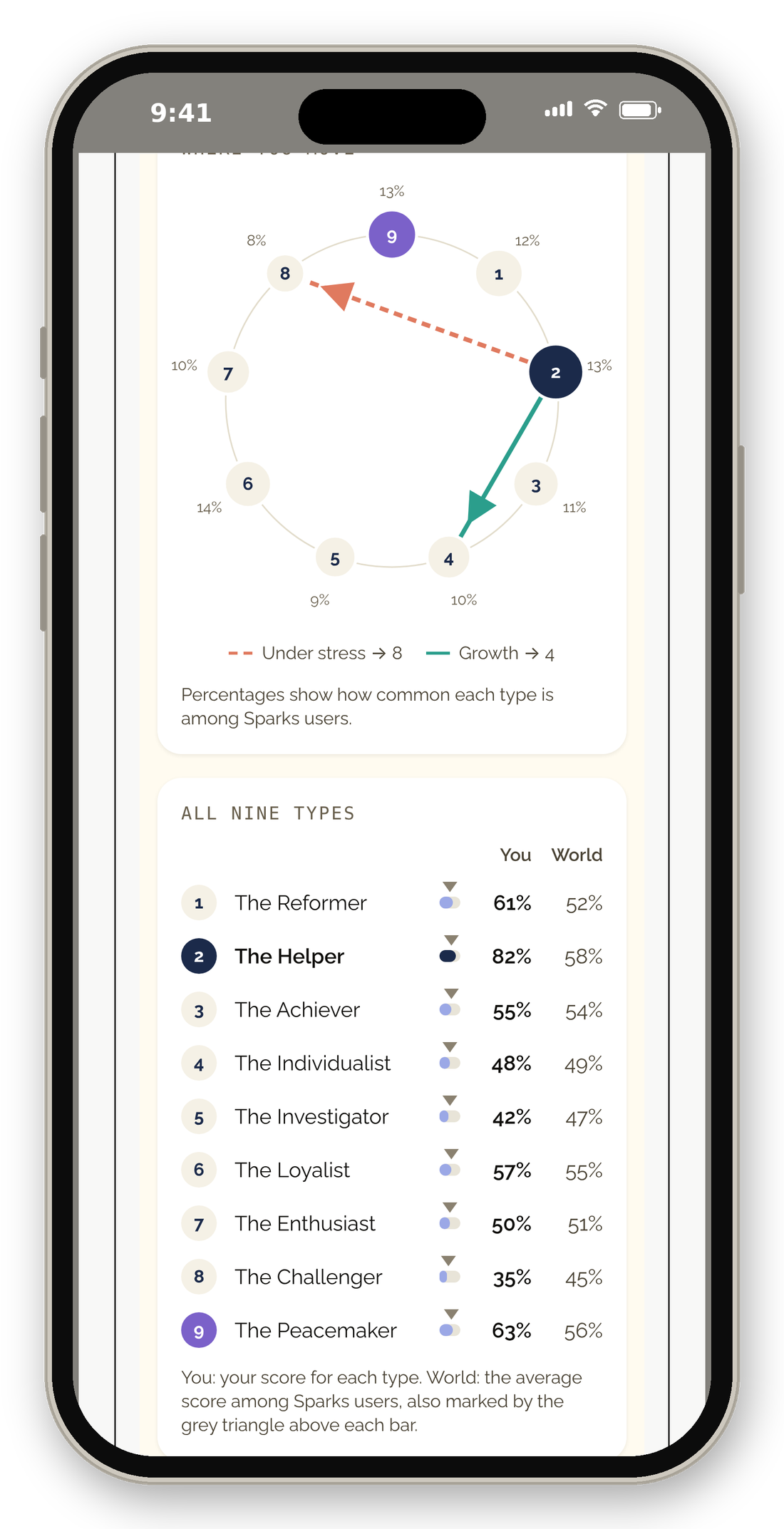
This person is a Type 2, the Helper, with a 1 wing. The circle is the part most tests leave out. The dashed arrow shows where they move under stress: toward 8, where a Helper can become blunt and controlling when their help goes unnoticed. The solid arrow shows growth: toward 4, the best of the Individualist.
The Me vs the world view adds how common each type is among SPARKS users, and sets every score beside the world average. The Helper scores 82 percent against a world average of 58. The Peacemaker, their second-highest type, scores 63 against 56.
The screen shows sample data from the SPARKS app.
How SPARKS goes further
Every Enneagram test tells you your type. SPARKS Relational Intelligence asks the next question: how does your type show up in the way you communicate and handle conflict, on a good day and on a hard one?
Your Enneagram result is combined with your Communication Style and Conflict Style, each measured at work, at home and in learning. A Type 5 may read as calm and assertive at work, where the facts are clear, then avoid conflict entirely at home, where feelings move faster than information. A Type 2 may accommodate for weeks, then compete hard once the ledger tips. The pattern is not random. It follows the motivation underneath.
That is the information SPARKS surfaces. The second sample above shows it: a Type 2’s communication result explains a swing from holding back to pushing hard through the Enneagram and attachment results together. A communication style result alone cannot explain that. An Enneagram type alone cannot predict it. Together, they can.
The Enneagram is one of the Core Five, with the Big Five, Attachment Style, Values and Beliefs, and Communication Style. Complete all five and you receive your Actionable Insights Report. You can also compare your result with groups of people like you, never with any individual.
Your type, in the way you communicate
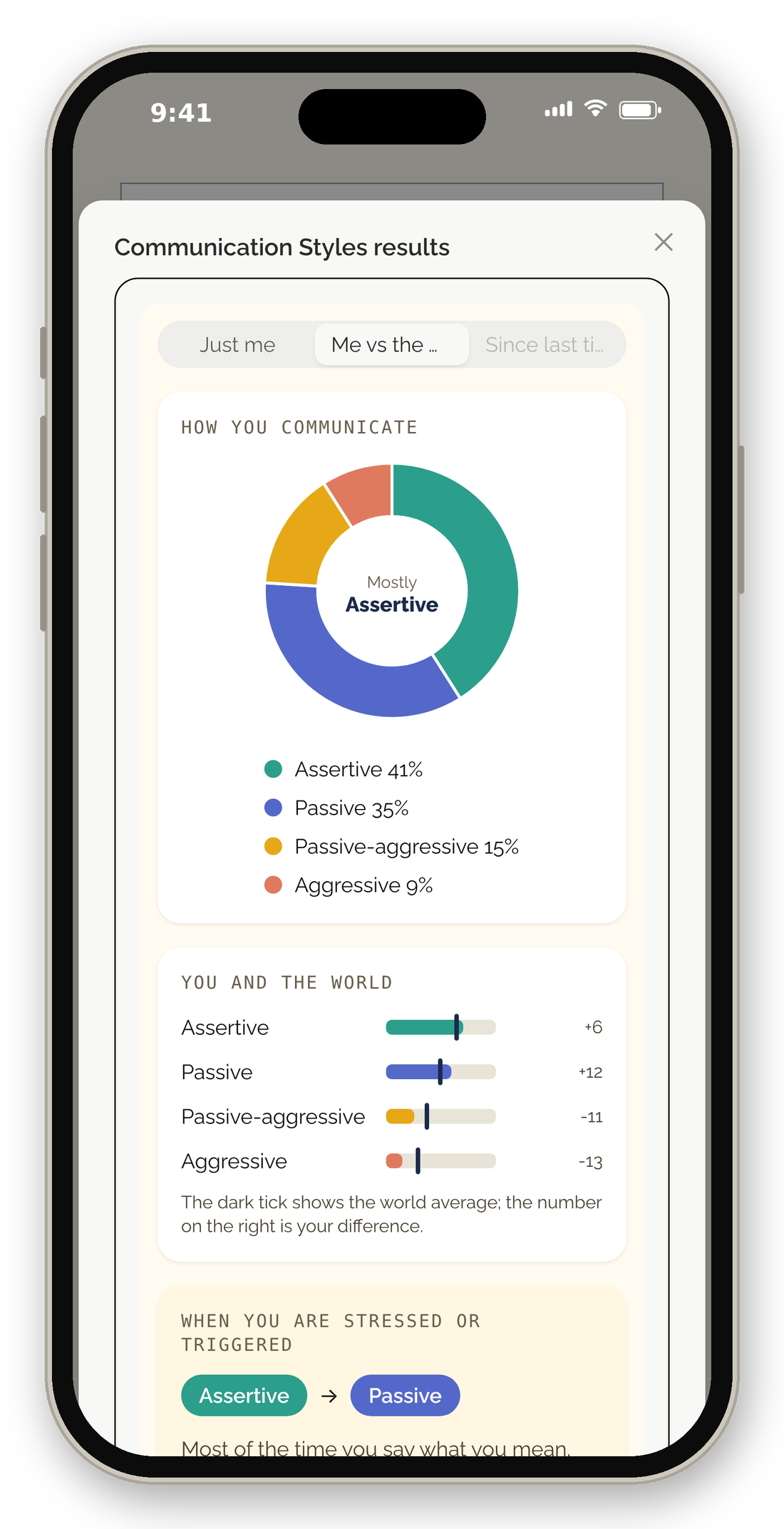
The same person’s Communication Style result shows where the Enneagram earns its place. They are mostly assertive, and they are passive more often than most people: 12 points above the world average.
Further down, the result explains the swing under stress from assertive to passive through two other results: an attachment pull toward worry, and a Type 2’s tendency to turn blunt and controlling when help goes unnoticed. Neither result alone explains it. Together, they do.
The screen shows sample data from the SPARKS app.
Questions
Enneagram questions
What are the nine Enneagram types?
The Reformer (1), Helper (2), Achiever (3), Individualist (4), Investigator (5), Loyalist (6), Enthusiast (7), Challenger (8) and Peacemaker (9). Each is built around a core motivation.
What is an Enneagram wing?
Wings are the two types next to yours on the Enneagram circle. Most people lean toward one of them, which adds flavor to the dominant type. Your result shows your score for both.
What happens to my Enneagram type under stress?
Enneagram teaching describes a stress point for each type, where you take on the less healthy traits of another type. SPARKS sets your type beside your communication and conflict styles, so you can see how that shift plays out with real people.
Is the Enneagram scientific?
The evidence is growing but mixed. A 2021 systematic review found reasonable reliability and called for more validity research. SPARKS pairs the Enneagram with the Big Five, which has the strongest research base in personality science.
Can my Enneagram type change?
Your core type is usually stable. How healthily you live it, and how often stress pulls you toward your stress point, can change a great deal.
How long does the Enneagram test take?
About ten minutes. It is one of the two longest assessments in SPARKS, with the Big Five, and one of the most useful.
Related assessments
- Big Five: the trait scores that sit underneath your type
- Communication Style: how your type sounds when you are under pressure
- Conflict Style: what your type does when a disagreement starts
From High on Healthy
Conversations on personality and self-awareness from the High on Healthy podcast.
- Finding Authenticity in a Hyper-Visible World with Dr. Joshua EstrinAuthenticity does not mean being one fixed self, because a person can show different versions of themselves on different platforms and still be honest in each one.
- Redefining Self-Improvement and Healing with Samantha DeCaroSelf-improvement messages in our culture often focus on appearance, which is a goal no one can ever finish reaching.
- Unlocking Unconscious Memory: Shale Maulana on Trauma, Dreams, and RegulationThe conscious mind works like a flashlight in a warehouse, so it can only light a small part of what a person carries from lived experience.
All Personality and Self-Awareness →
Sources
The Enneagram assessment in SPARKS draws on this research. See every reference.
- Riso, D. R., and Hudson, R. (1999). The Wisdom of the Enneagram. Bantam.
- Naranjo, C. (1994). Character and Neurosis: An Integrative View. Gateways/IDHHB.
- Hook, J. N., Hall, T. W., Davis, D. E., Van Tongeren, D. R., and Conner, M. (2021). The Enneagram: A systematic review of the literature and directions for future research. Journal of Clinical Psychology, 77(4), 865-883.
- Newgent, R. A., Parr, P. E., Newman, I., and Higgins, K. K. (2004). The Riso-Hudson Enneagram Type Indicator: Estimates of reliability and validity. Measurement and Evaluation in Counseling and Development, 36(4), 226-237.
Your answers stay yours. No one sees your answers, and your results stay private unless you choose to share them. If your organization offers SPARKS, it sees only groups of 30 people or more, never you.