
Global · Leadership
Leadership Style Assessment: Leadership Across Contexts
Leadership is not one trait. Almost everyone leads strongly in one setting and holds back in another, and no job title reveals which. This assessment measures how you lead in four contexts, including the revealing one: what you do when no one is in charge.
About five minutes. Your results appear as soon as you finish.
Leadership Across Contexts1:05
What the leadership style assessment measures
Situational leadership research has long argued that good leaders change how they lead with the situation (Tannenbaum and Schmidt, 1958; Hersey and Blanchard, 1969; Vroom and Yetton, 1973). Research on leadership emergence asks a different question: who steps up when nobody has been appointed (Ensari et al., 2011)? Research on personal initiative shows that acting without being told is its own skill (Frese and Fay, 2001).
Leadership Across Contexts brings those together. Sixteen realistic situations, in the style of a situational judgment test (McDaniel et al., 2001), measure two things in four contexts:
- Initiative: do you act, or wait?
- Style: when you act, are you directive (take charge, decide, assign) or facilitative (convene, structure, share the decision)?
Your result shows initiative in four contexts: with your manager, in a team, across the organization, and when no one leads.
What each leadership profile means
Neither directive nor facilitative style is ranked above the other; each wins in different situations.
Commander
High initiative, directive style. You step in and take charge. Fast and clear in a crisis; the risk is that others stop stepping up.
Convener
High initiative, facilitative style. You step in by bringing people together and structuring the decision. Strong buy-in; the risk is slowness when a call is needed now.
Situational
High initiative, with a style that changes with the situation. You lead often, and adjust how.
Executor
Lower initiative, directive style. You wait for the mandate, then deliver decisively. Reliable inside a clear structure.
Anchor
Lower initiative, facilitative style. You steady a group, and you are the person others confide in. Many people discover that what they never called leadership is exactly that. The Anchor profile exists to make it visible.
The Emergence Index
Your initiative in the vacuum context: whether you step up when no one is in charge, or wait for an invitation. Both patterns matter, and neither is shamed.
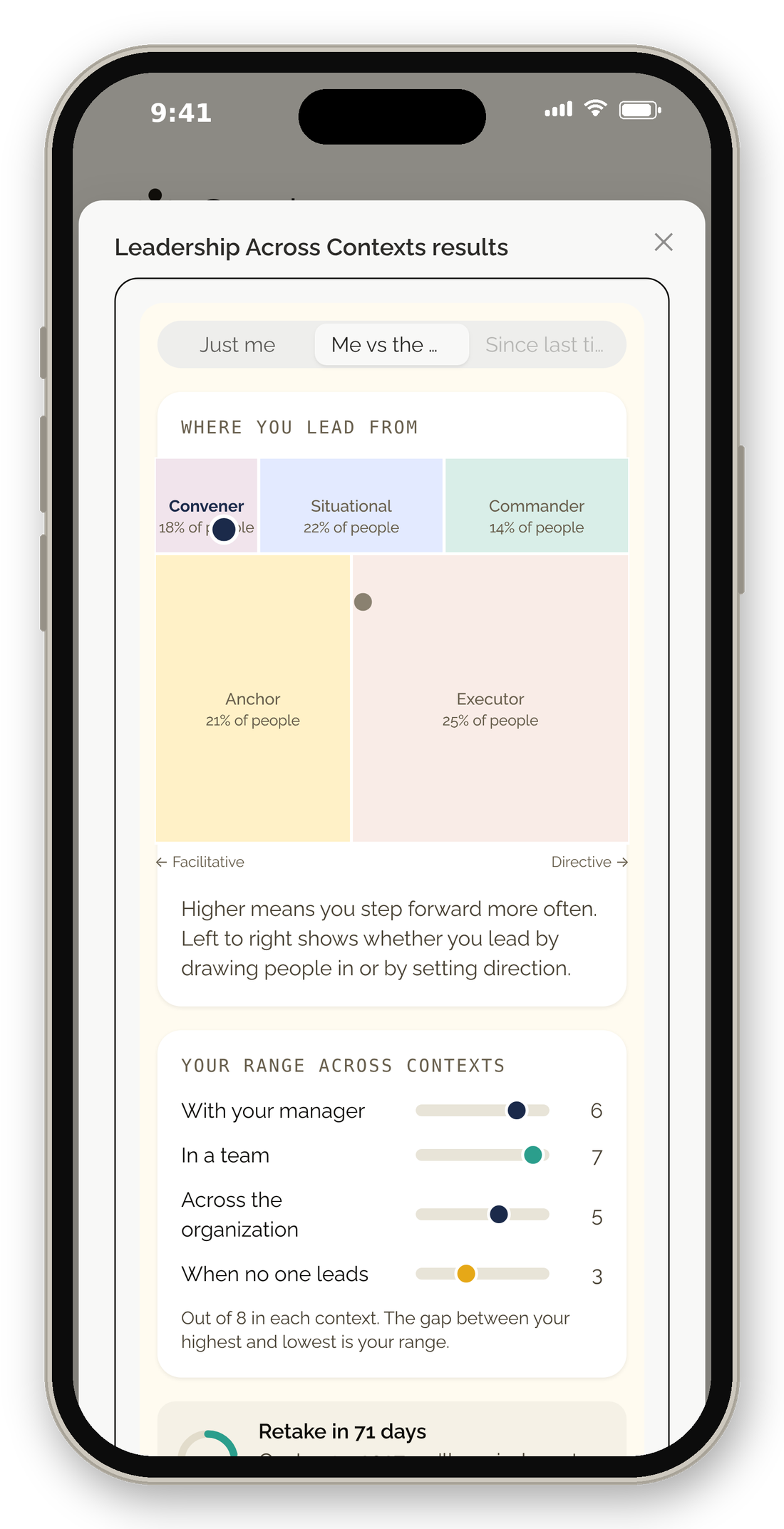
Reading a sample result
This person is a Convener: high initiative, with a facilitative style. They step forward often, and lead by drawing people in rather than setting direction.
The Me vs the world view adds how common each profile is, and a grey dot for the global average, which sits lower and toward directive. Conveners are 18 percent of people; Executors, the most common, are 25.
“Your range across contexts” shows initiative out of 8: 6 with their manager, 7 in a team, 5 across the organization, and 3 when no one leads. This person leads readily inside a structure, and holds back when no one is in charge.
The screen shows sample data from the SPARKS app.
How SPARKS goes further
Leadership Across Contexts shows where and how you step up. SPARKS Relational Intelligence reads it with the rest of the leadership set and your core profile.
The Authority Blueprint shows how you use power once you have it. Metacognitive Awareness shows whether the confidence others follow is well calibrated. Your Big Five scores and Conflict Style explain the pattern underneath: a Commander with low agreeableness and a competing conflict style leads very differently from a Commander who collaborates.
The set sits on the Global path, because leadership shows up in families, committees and friendships as much as at work. You can compare your result with groups of people like you, never with any individual.
Questions
Leadership style questions
What are the leadership profiles?
Commander, Convener, Situational, Executor and Anchor. They come from two measures: how readily you take initiative, and whether your style is directive or facilitative.
Is directive leadership better than facilitative?
No. Directive leadership wins in a crisis; facilitative leadership wins when buy-in matters. The skill is knowing which a moment needs.
What is the Emergence Index?
Your initiative when no one is in charge. It shows whether you step up in a vacuum or wait for an invitation.
I am not a manager. Is this for me?
Yes. Two of the four contexts involve no formal authority at all, and the Anchor profile describes leadership that rarely comes with a title.
How long does it take?
About five minutes: sixteen short situations.
Related assessments
- The Authority Blueprint: how you use power once you have it
- Metacognitive Awareness: whether the confidence others follow is well placed
- Conflict Style: what you do when leading turns into disagreement
From High on Healthy
Conversations on leadership and work from the High on Healthy podcast.
- Navigating AI: Trust, Critical Thinking, and Human ConnectionAI can influence you only if you use it, so the first defense is to use it with intention instead of by default.
- The Silent Crisis of Success: Nick Jonsson on Redefining Executive LonelinessLoneliness often grows at work because each step up the ladder rewards looking strong, so people hide weakness and stop asking for help.
- Unmasking High-Functioning Depression and Emotional BankruptcyLaura Ramos says high achievers are praised for doing rather than feeling, so they learn that achievement is safer than vulnerability.
Sources
The Leadership Across Contexts assessment in SPARKS draws on this research. See every reference.
- Tannenbaum, R., and Schmidt, W. H. (1958). How to choose a leadership pattern. Harvard Business Review, 36(2), 95-101.
- Hersey, P., and Blanchard, K. H. (1969). Life cycle theory of leadership. Training and Development Journal, 23(5), 26-34.
- Vroom, V. H., and Yetton, P. W. (1973). Leadership and Decision-Making. University of Pittsburgh Press.
- Frese, M., and Fay, D. (2001). Personal initiative: An active performance concept for work in the 21st century. Research in Organizational Behavior, 23, 133-187.
- Ensari, N., Riggio, R. E., Christian, J., and Carslaw, G. (2011). Who emerges as a leader? Meta-analyses of individual differences as predictors of leadership emergence. Personality and Individual Differences, 51(4), 532-536.
- McDaniel, M. A., Morgeson, F. P., Finnegan, E. B., Campion, M. A., and Braverman, E. P. (2001). Use of situational judgment tests to predict job performance. Journal of Applied Psychology, 86(4), 730-740.
Your answers stay yours. No one sees your answers, and your results stay private unless you choose to share them. If your organization offers SPARKS, it sees only groups of 30 people or more, never you.