
Personality · Big Five
Big Five Personality Test (OCEAN)
The Big Five is the most widely researched model of personality in psychology. It scores you on five traits, each a spectrum rather than a box: openness, conscientiousness, extraversion, agreeableness and neuroticism. It is the place to start, because almost everything else in SPARKS builds on it.
About ten minutes. Your results appear as soon as you finish.
The Big Five1:06
What the Big Five personality test measures
The Big Five grew out of decades of research into the words people use to describe each other. When researchers analyzed those descriptions, the same five broad factors kept appearing, across languages and across methods (Goldberg, 1992; McCrae and Costa, 1987). Paul Costa and Robert McCrae built the NEO inventories on the model, and the International Personality Item Pool made research-grade Big Five items openly available (Goldberg et al., 2006).
The model’s strength is prediction. Big Five scores are linked to job performance, health, relationship satisfaction and how long people live, with effects comparable to income and cognitive ability (Roberts et al., 2007).
The SPARKS assessment places you on each of the five traits, from low to high. There are no types and no pass marks. Every point on every scale has strengths and costs.
What each Big Five trait means
Openness to experience
Curiosity, imagination and appetite for new ideas. High scorers seek novelty and complexity, and can tire of routine. Low scorers prefer the familiar and the proven, and tend to be practical and grounded.
Conscientiousness
Organization, reliability and follow-through. High scorers plan, finish and hold themselves to a standard. Low scorers are more flexible and spontaneous, and can find structure confining.
Extraversion
Where you get your energy. High scorers draw energy from people and activity, and think out loud. Low scorers recharge alone, and tend to think before they speak.
Agreeableness
Warmth, trust and the wish to keep things harmonious. High scorers cooperate and accommodate, sometimes at their own expense. Low scorers are more skeptical and direct, and more willing to hold a hard line.
Neuroticism (emotional sensitivity)
How strongly you react to stress and setbacks. High scorers feel worry, frustration and low moods more intensely and for longer. Low scorers stay steadier under pressure, and can sometimes miss early warning signs in themselves.
No trait is good or bad on its own. What matters is the combination, and the situation you are in.
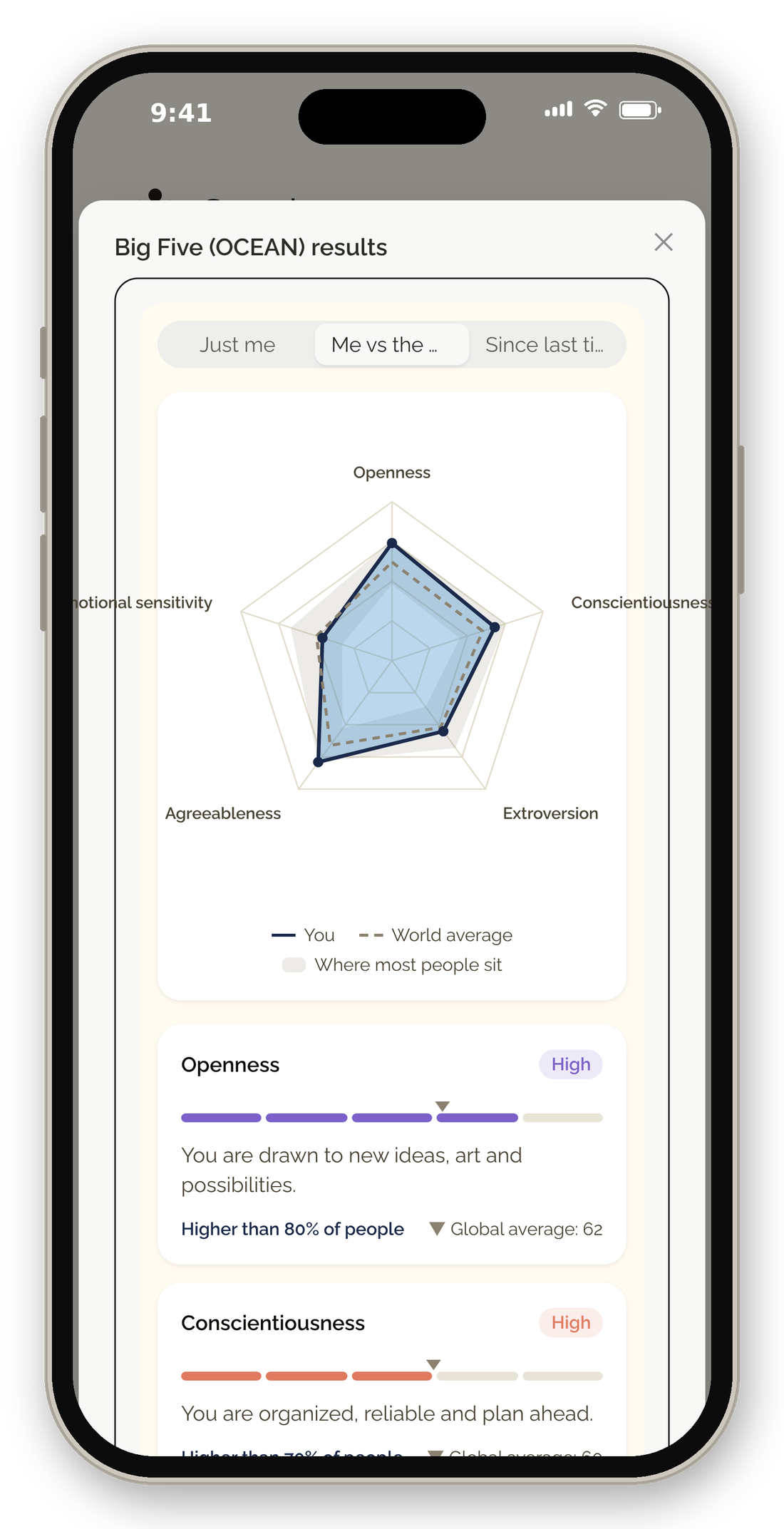
Reading a sample result
The solid line is this person; the dashed line is the world average; the grey band is where most people sit. Their shape reaches past the average on Openness, Conscientiousness and Agreeableness.
Each trait card then puts the score in context: Openness is High, “higher than 80% of people”, with the global average marked on the bar. Emotional sensitivity is the app’s plain-language name for neuroticism.
Comparisons are always with groups of people, never with any individual.
The screen shows sample data from the SPARKS app.
How SPARKS goes further
A Big Five result describes how you tend to behave. It does not say why, how you bond with people, or what you do in a disagreement. Each of those has its own assessment, built by researchers to answer one narrow question well.
SPARKS Relational Intelligence combines them. Your Big Five scores sit underneath every other result in your profile, the Sparks Prism. High Agreeableness reads one way next to a Type 2 Enneagram and an accommodating conflict style, and another way next to a Type 8 and a competing one. The combination is where the useful insight is.
The Big Five is also where personalization starts. Once you finish it, the Communication Coach and the Reflection Journal begin to tailor what they say to you. You can compare your scores with groups of people like you, never with any individual.
From traits to how you communicate
Your reports take the next step. One report reads Big Five scores together with your type: high extraversion and openness explain an assertive, curious way of talking; high agreeableness explains why that assertiveness lands as warm rather than combative.
No single assessment could produce that paragraph. It comes from reading the results together.
The Big Five is one of the Core Five, with the Enneagram, Attachment Style, Values and Beliefs, and Communication Style. Complete all five and you receive your Actionable Insights Report.
Questions
Big Five questions
What are the Big Five personality traits?
Openness to experience, conscientiousness, extraversion, agreeableness and neuroticism, often remembered as OCEAN. Each is a spectrum, and everyone sits somewhere on all five.
How accurate is the Big Five?
It is the best-supported model of personality in research. The five factors appear across languages, cultures and measurement methods, and scores predict real outcomes such as job performance and health.
What is the difference between the Big Five and the 16 personality types?
The Big Five gives you a score on each trait. Type systems sort people into categories. Research has found that the four type preferences line up closely with four of the Big Five traits. SPARKS offers both and reads them together.
Can my Big Five scores change?
Traits are fairly stable in adulthood, but they do shift. Conscientiousness and agreeableness tend to rise with age, and neuroticism tends to fall. Retaking the test every year or so shows your trend.
Is a high neuroticism score bad?
No. It means you feel stress and setbacks more intensely. That sensitivity often comes with early awareness of problems. Knowing it helps you plan for the moments that cost you most.
Why start with the Big Five?
It is the foundation the rest of your profile builds on, and it is the assessment that starts personalizing the Communication Coach and Reflection Journal.
Related assessments
- Enneagram: the motivation underneath your traits
- 16 Types: your traits expressed as a type preference
- Communication Style: how your traits sound in conversation
From High on Healthy
Conversations on personality and self-awareness from the High on Healthy podcast.
- Finding Authenticity in a Hyper-Visible World with Dr. Joshua EstrinAuthenticity does not mean being one fixed self, because a person can show different versions of themselves on different platforms and still be honest in each one.
- Redefining Self-Improvement and Healing with Samantha DeCaroSelf-improvement messages in our culture often focus on appearance, which is a goal no one can ever finish reaching.
- Unlocking Unconscious Memory: Shale Maulana on Trauma, Dreams, and RegulationThe conscious mind works like a flashlight in a warehouse, so it can only light a small part of what a person carries from lived experience.
All Personality and Self-Awareness →
Sources
The Big Five assessment in SPARKS draws on this research. See every reference.
- Goldberg, L. R. (1992). The development of markers for the Big-Five factor structure. Psychological Assessment, 4(1), 26-42.
- McCrae, R. R., and Costa, P. T., Jr. (1987). Validation of the five-factor model of personality across instruments and observers. Journal of Personality and Social Psychology, 52(1), 81-90.
- Costa, P. T., Jr., and McCrae, R. R. (1992). Revised NEO Personality Inventory (NEO-PI-R) and NEO Five-Factor Inventory (NEO-FFI) professional manual. Psychological Assessment Resources.
- Goldberg, L. R., Johnson, J. A., Eber, H. W., Hogan, R., Ashton, M. C., Cloninger, C. R., and Gough, H. G. (2006). The International Personality Item Pool and the future of public-domain personality measures. Journal of Research in Personality, 40(1), 84-96.
- Roberts, B. W., Kuncel, N. R., Shiner, R., Caspi, A., and Goldberg, L. R. (2007). The power of personality. Perspectives on Psychological Science, 2(4), 313-345.
Your answers stay yours. No one sees your answers, and your results stay private unless you choose to share them. If your organization offers SPARKS, it sees only groups of 30 people or more, never you.