
Relationships · Conflict
Conflict Style Assessment
Some people push, some give way, some go quiet, some split the difference, and some dig in until the real problem is solved. This assessment shows which of the five conflict modes you reach for first, and how that changes between work, home and learning.
About five to ten minutes for each edition. Your results appear as soon as you finish.
Conflict Style1:05
What the conflict style assessment measures
The five conflict modes come from a simple idea. In any disagreement you balance two concerns: getting what you need (assertiveness), and helping the other person get what they need (cooperativeness). Robert Blake and Jane Mouton first mapped this grid for managers (1964). Kenneth Thomas and Ralph Kilmann turned it into the five modes and a forced-choice measure (Thomas and Kilmann, 1974; Kilmann and Thomas, 1977). M. Afzalur Rahim built a related measure of the same five styles (Rahim, 1983).
The SPARKS assessment follows the five-mode model. It is not the Thomas-Kilmann instrument. It comes in three editions, work, home and learning, because most people handle conflict differently with a manager, a partner and a classmate.
What each conflict style means
Competing
High assertiveness, low cooperation. You hold your position and push for it. Useful in an emergency or when a principle is at stake. Costly when it becomes the default, because people stop bringing you bad news.
Collaborating
High assertiveness, high cooperation. You work to find a solution that fully meets both sides. It produces the best outcomes on important issues, and it takes time that small issues do not deserve.
Compromising
Middle on both. You split the difference so everyone gets part of what they want. Fast and fair-seeming, though the real problem can survive the deal.
Avoiding
Low on both. You sidestep, postpone or change the subject. Wise when tempers are high or the issue is trivial. Costly when the issue grows quietly in the meantime.
Accommodating
Low assertiveness, high cooperation. You give the other person what they want to protect the relationship. Generous in the moment, and corrosive when it is the only move you have.
No style is best. Skilled people use all five and choose deliberately. The risk is the style you fall into under stress without choosing it.
Reading a sample result
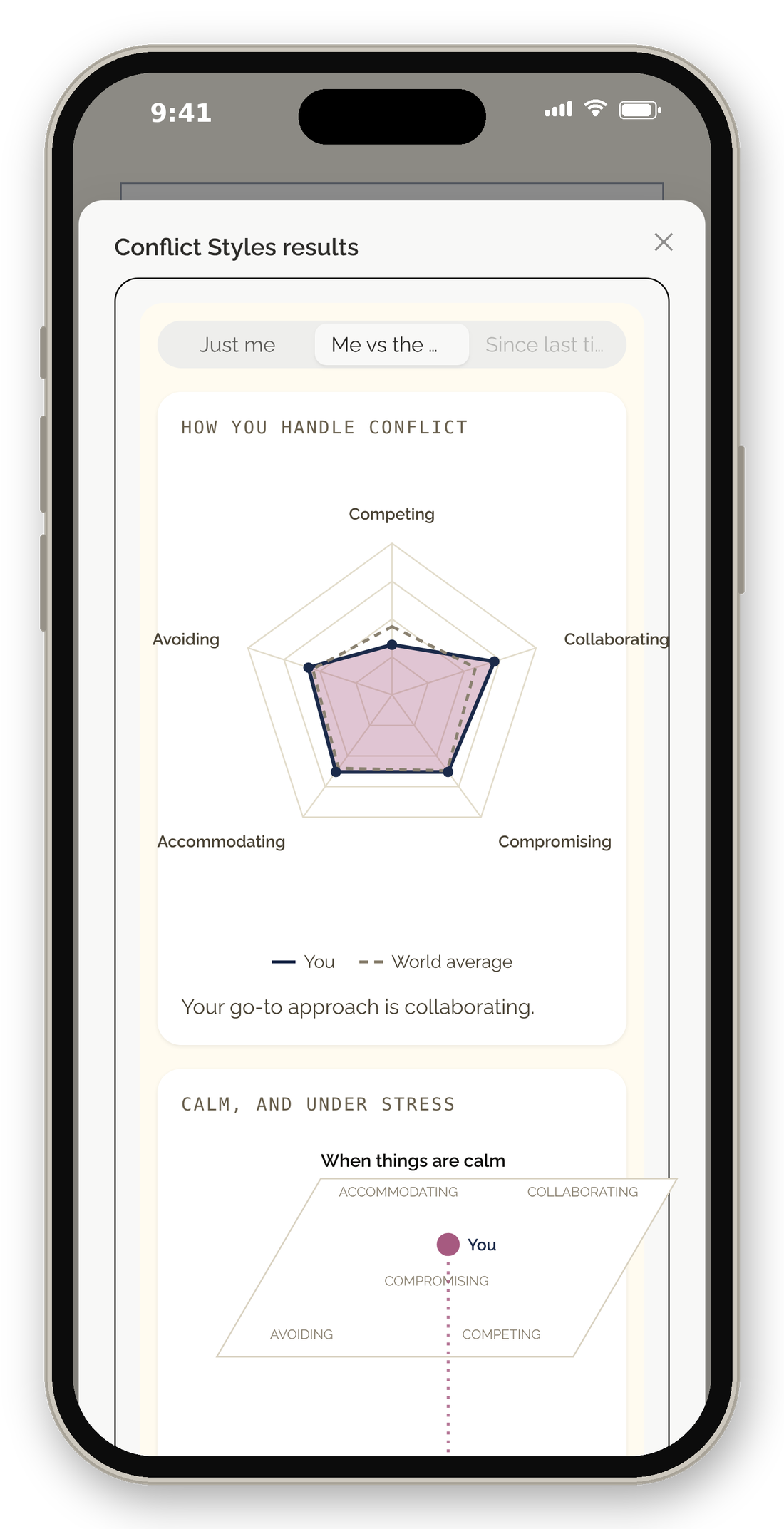
This person’s go-to approach is collaborating. The radar shows all five modes: the solid line is this person, the dashed line is the world average. They collaborate a little more than most people, and compete a little less.
Below the radar, “Calm, and under stress” shows two floors: where they sit when things are calm, and where they slide when they feel unsettled. For this person, the slide is toward accommodating. The drop between the floors is the pull their attachment pattern puts on them under stress.
The screen shows sample data from the SPARKS app.
How SPARKS goes further
A conflict style tells you what you do in a disagreement. On its own, it cannot tell you why, or why you do something different at home than at work. That is where most people get stuck.
SPARKS Relational Intelligence answers that by reading your results together. Your conflict style is combined with your Attachment Style and Communication Style to build your Relationship Lens. Your Enneagram type explains the motivation, and your Big Five scores explain how strongly you react under stress. Someone who competes at work and avoids at home is often not inconsistent. The stakes feel different, and the pattern underneath explains which way they go.
Your result shapes the advice the Communication Coach gives before a difficult conversation and the prompts in the Reflection Journal after one. You can compare your result with groups of people like you, never with any individual.
Questions
Conflict style questions
What are the five conflict styles?
Competing, collaborating, compromising, avoiding and accommodating. They come from two concerns in any disagreement: meeting your own needs and meeting the other person’s.
Which conflict style is best?
None. Each one fits some situations and backfires in others. The goal is to choose your style deliberately rather than fall into one under pressure.
Is avoiding conflict always bad?
No. Avoiding is wise when tempers are high, when the issue is trivial, or when you need time to think. It becomes a problem when it is your only response and issues grow in the silence.
Why is my result different at work and at home?
Because the stakes and the relationships are different. That is why there are three editions. The difference between them is often the most useful part of your result.
Is this the Thomas-Kilmann instrument?
No. It is built on the same five-mode model that the Thomas-Kilmann instrument uses, with its own questions and three editions.
How long does the conflict style assessment take?
Five to ten minutes for each edition.
Related assessments
- Communication Style: how you sound when the conflict starts
- Attachment Styles: why some disagreements feel like a threat to the relationship
- Enneagram: the motivation behind the conflict mode you reach for
From High on Healthy
Conversations on relationships, communication and conflict from the High on Healthy podcast.
- Navigating AI’s Impact on Mental Health and RelationshipsAn AI can only reflect back what you report, so if you describe yourself as emotionally available, it has no way to see what you leave out.
- How Psychedelic-Assisted Therapy Transforms RelationshipsEmpathy starts with a safe enough environment, because lowering your defenses only makes sense when what you reveal will not be used against you.
- Healing the Inner Child: Moving Beyond Patterns to WholenessChildhood pain does not have to be extreme abuse, because a parent who was often absent can teach a child to believe they cannot depend on others.
All Attachment and Relationships →
Sources
The Conflict Style assessment in SPARKS draws on this research. See every reference.
- Blake, R. R., and Mouton, J. S. (1964). The Managerial Grid. Gulf Publishing.
- Thomas, K. W., and Kilmann, R. H. (1974). Thomas-Kilmann Conflict Mode Instrument. Xicom.
- Kilmann, R. H., and Thomas, K. W. (1977). Developing a forced-choice measure of conflict-handling behavior: The "MODE" instrument. Educational and Psychological Measurement, 37(2), 309-325.
- Rahim, M. A. (1983). A measure of styles of handling interpersonal conflict. Academy of Management Journal, 26(2), 368-376.
Your answers stay yours. No one sees your answers, and your results stay private unless you choose to share them. If your organization offers SPARKS, it sees only groups of 30 people or more, never you.