
Relationships · Workplace · Learning
Communication Style Quiz
There is often a wide gap between how you mean to come across and how you land. This assessment maps your everyday style, direct or indirect and expressive or reserved, then shows the mode you fall back on under pressure: passive, aggressive, passive-aggressive or assertive.
About five to ten minutes for each edition. Your results appear as soon as you finish.
Communication Style1:06
What the communication style quiz measures
The assessment has two parts. The first maps how you express yourself day to day, on two axes. The second identifies the mode you fall back on when the stakes rise.
The pressure modes are grounded in decades of research on assertiveness. Joseph Wolpe described assertive behavior in early clinical work (Wolpe, 1958). Robert Alberti and Michael Emmons brought it to a wide audience in Your Perfect Right (1970), and Arthur Lange and Patricia Jakubowski set out the distinction between assertive, passive and aggressive responses that trainers still use (1976). A 2018 review called assertiveness training a forgotten evidence-based treatment (Speed, Goldstein and Goldfried, 2018).
Many people communicate differently at home, at work and when they learn. So the assessment comes in three editions: one for the workplace, one for how you learn, and one for personal relationships. Together they show how and why you interact differently in different settings.
What each communication style means
Direct or indirect
Direct communicators state the point first. Indirect communicators build context and leave room for the other person to infer. Neither is more honest. They reflect different ideas of what is polite, and each is heard as rude by the other.
Expressive or reserved
Expressive communicators show emotion and energy. Reserved communicators keep feelings in the background and let the facts carry the message. Where you sit on both axes is your everyday style, how most people experience you most of the time.
Passive
Under pressure, you hold back your needs to avoid friction. Others may not know what you want until it is too late, and you may end up feeling overlooked.
Aggressive
Under pressure, you state your needs at the expense of others: interrupting, blaming, overriding. You are heard, but people stop listening.
Passive-aggressive
Under pressure, you hold back directly and push back indirectly, through tone, delay, sarcasm or quiet resistance. The message arrives, but sideways.
Assertive
Under pressure, you state your needs clearly and respect the other person’s. This is the mode research links to healthier relationships and lower stress, and it can be learned.
Reading a sample result
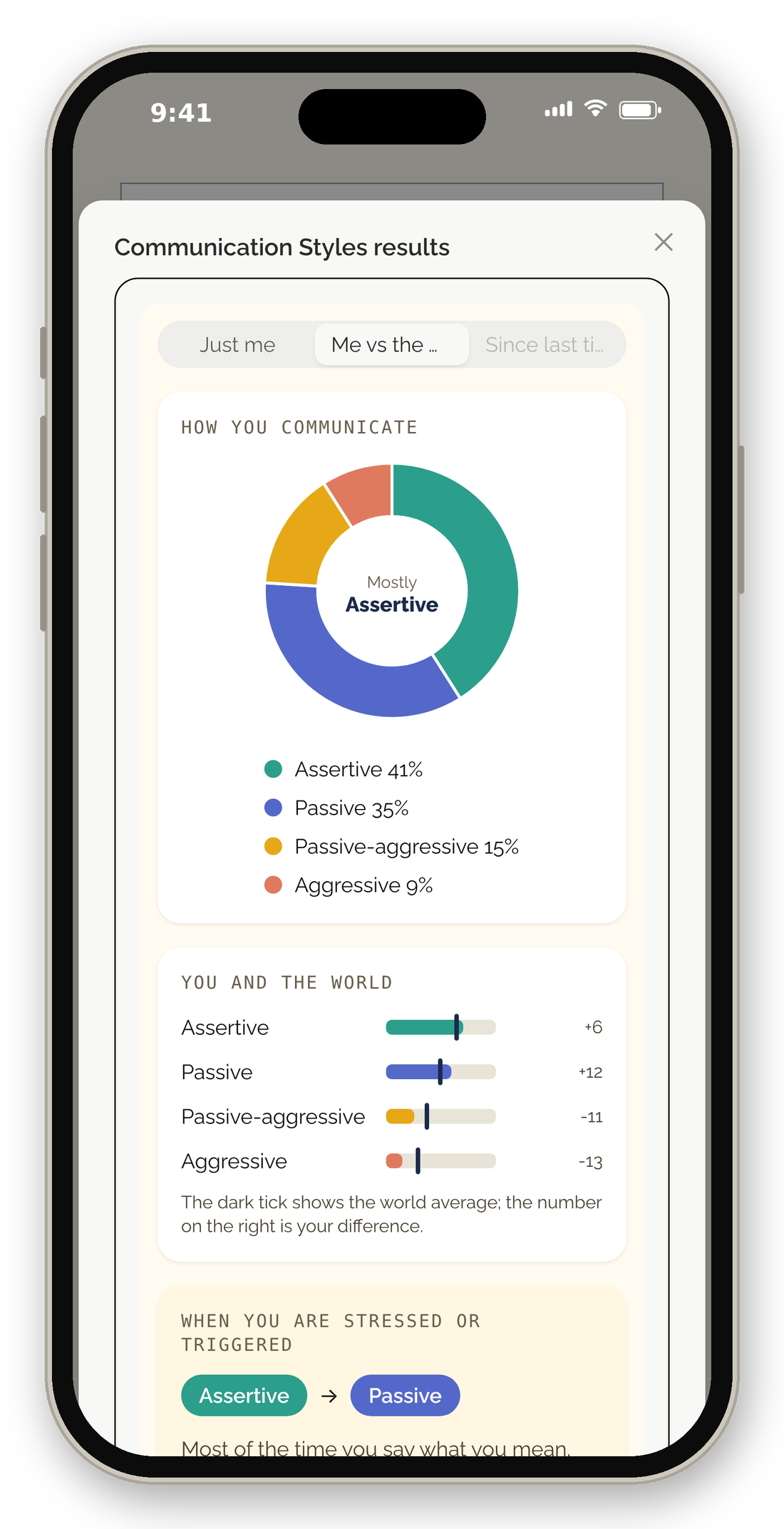
This person is mostly assertive: 41 percent, with passive at 35 percent.
The Me vs the world view adds “You and the world”. The dark tick on each bar is the world average; the number is the difference. This person is 6 points more assertive than average, and 12 points more passive. They are well below average on aggressive and passive-aggressive.
The card below shows what happens under stress: Assertive turns to Passive. The explanation reaches into their attachment and Enneagram results to say why.
The screen shows sample data from the SPARKS app.
How SPARKS goes further
A communication style describes how you come across. It cannot tell you why you switch modes under pressure, or why the same words that work with one colleague fail with another. Those answers sit in other assessments.
SPARKS Relational Intelligence reads them together. Your communication style is combined with your Attachment Style and Conflict Style to build your Relationship Lens. Your Big Five scores and Enneagram type explain the pattern underneath. A reserved, assertive communicator with high agreeableness lands as calm and fair. The same style with low agreeableness can land as cold. Same words, different person, different effect.
Communication Style is one of the Core Five, and it drives the Communication Coach, which suggests wording that sounds like you and fits the person you are writing to, in Gmail, Outlook and on your phone keyboard. You can compare your result with groups of people like you, never with any individual.
Questions
Communication style questions
What are the four communication styles?
Passive, aggressive, passive-aggressive and assertive. They describe how you respond when the stakes rise. SPARKS also maps your everyday style: direct or indirect, and expressive or reserved.
Is direct communication better than indirect?
No. Each works well with people who share it and causes friction with people who do not. The skill is recognizing the difference and adjusting.
Can I become more assertive?
Yes. Assertiveness is a skill rather than a fixed trait, and training in it has a long research base. Knowing your current default under pressure is the starting point.
Why are there three versions?
Many people communicate differently with colleagues, partners and classmates. The three editions show where your style shifts.
How is my communication style result used?
It shapes the suggestions from the Communication Coach, so the wording it offers sounds like you and lands well with the person you are writing to.
How long does the communication style quiz take?
Five to ten minutes for each edition.
Related assessments
- Conflict Style: what you do once the conversation turns into a disagreement
- Attachment Styles: why some conversations feel riskier than others
- Social Styles: how others read your style at work
From High on Healthy
Conversations on communication from the High on Healthy podcast.
- Navigating Political Polarization and Historical ParallelsSocial media is an artificial setting where people say things they would never say in person, and that habit has carried into how we treat family, friends and co-workers.
- Navigating AI’s Impact on Mental Health and RelationshipsAn AI can only reflect back what you report, so if you describe yourself as emotionally available, it has no way to see what you leave out.
- Overcoming Polarization Through Meta-PerceptionsMeta-perceptions, meaning what we believe the other side thinks of us, shape hostility as much as our direct views of them do.
Sources
The Communication Style assessment in SPARKS draws on this research. See every reference.
- Wolpe, J. (1958). Psychotherapy by Reciprocal Inhibition. Stanford University Press.
- Alberti, R. E., and Emmons, M. L. (2017). Your Perfect Right: Assertiveness and Equality in Your Life and Relationships (10th ed.). New Harbinger. (Original work published 1970)
- Lange, A. J., and Jakubowski, P. (1976). Responsible Assertive Behavior: Cognitive/Behavioral Procedures for Trainers. Research Press.
- Speed, B. C., Goldstein, B. L., and Goldfried, M. R. (2018). Assertiveness training: A forgotten evidence-based treatment. Clinical Psychology: Science and Practice, 25(1), e12216.
Your answers stay yours. No one sees your answers, and your results stay private unless you choose to share them. If your organization offers SPARKS, it sees only groups of 30 people or more, never you.