
Well-being · Workplace
The Connection Check: Belonging Under Pressure
Cultures that reward stoicism produce people who are skilled at seeming fine, including to themselves. The Connection Check asks about observable facts of your recent weeks, not feelings, and shows how connected you are and how much of your support would survive a setback.
A few minutes. Your results are visible to you alone.
The Connection Check0:49
What the Connection Check measures
Research on social connection is clear: isolation is a health risk on the scale of well-known physical risks (Holt-Lunstad et al., 2015), and it changes how people think and react (Cacioppo and Hawkley, 2009). Robert Weiss distinguished two kinds of disconnection: the absence of a close bond, and the absence of a wider group (Weiss, 1973). Standard scales measure both (Russell, 1996; de Jong Gierveld and van Tilburg, 2006).
Those scales ask how you feel. That works poorly in high-performance cultures, where admitting struggle feels costly; studies of athletes and service members both find stigma as a barrier to seeking help (Gulliver, Griffiths and Christensen, 2012; Hoge et al., 2004).
So the Connection Check asks about frequencies instead: meals shared by choice, people who would check on you, nights of real sleep, conversations that went past logistics. Frequency questions resist masking far better than feeling questions do. It was built for student athletes, military academy students, and demanding teams and workplaces, and it works for anyone under sustained pressure.
What each part of your result means
The Connection Check produces a Connection Index, a plain reading of where you are right now, and clear domain scores. It never produces a diagnosis.
Your connection right now
A single reading on a gauge, with a plain description such as “Stretched”: real connections that are carrying a lot at the moment.
Emotional connection
Whether you have close people you actually talk to about more than logistics.
Belonging
Whether you feel part of a wider group: a team, a circle, a community.
An anchor person
Whether there is someone who would notice, and check on you, if something went wrong.
Room to breathe
How much space your schedule and situation leave for the people who matter.
Masking
How strongly you hide how you are really doing. If you are a masker, the pattern is named gently as a skill with a cost, never as a flaw.
Identity concentration
How much of your sense of self rests on a single part of your life, such as performance. When worth depends on one thing, an injury, a setback or a role change can take out everything at once.
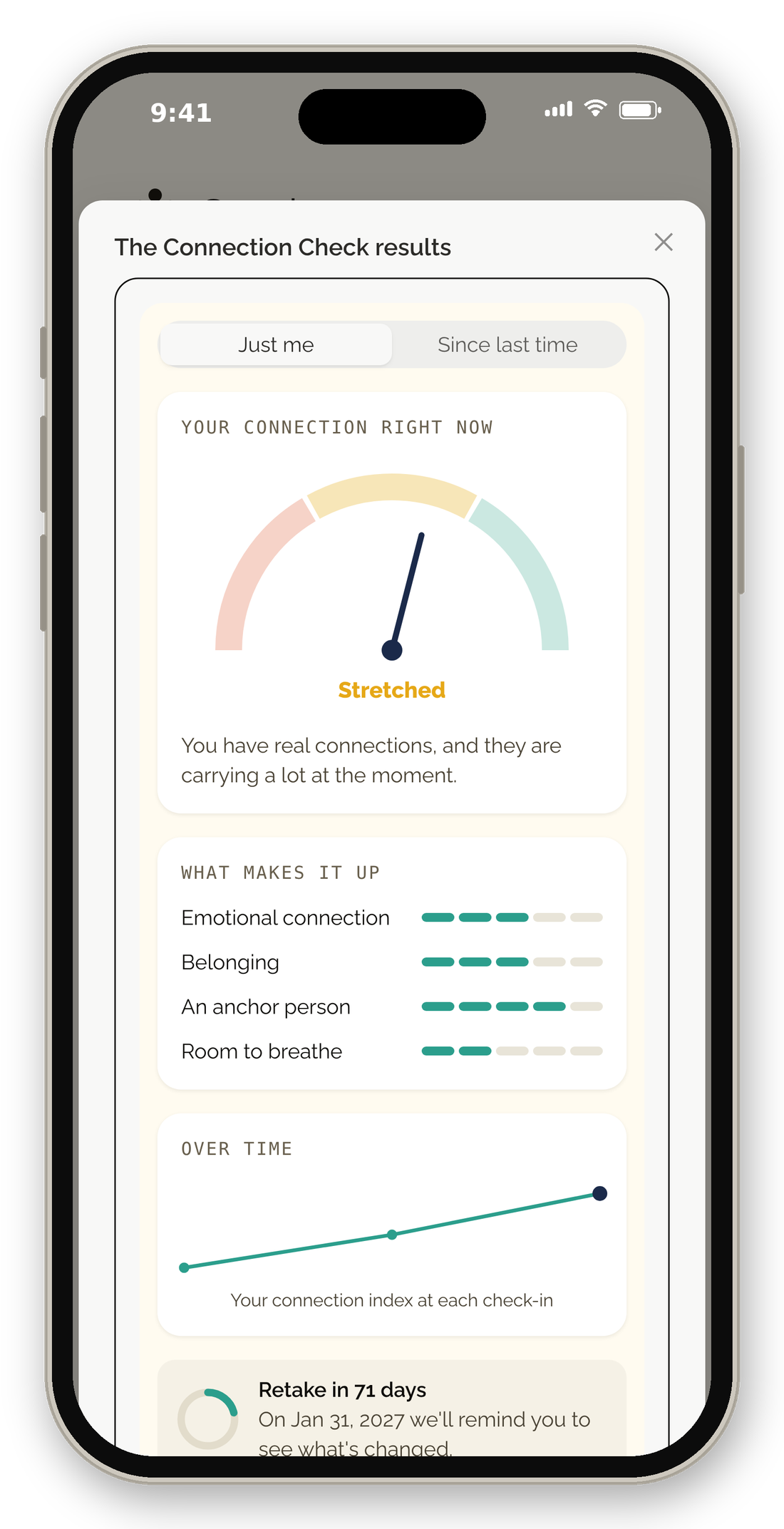
Reading a sample result
This person’s connection right now reads “Stretched”: they have real connections, and those connections are carrying a lot at the moment.
“What makes it up” shows the parts: emotional connection, belonging, an anchor person, and room to breathe. Here the anchor person is strongest and room to breathe is lowest.
The line under “Over time” matters more than any single reading. The Connection Check has no world comparison: your result is compared only with your own earlier check-ins.
The screen shows sample data from the SPARKS app.
How SPARKS goes further
The Connection Check is deliberately separate. Your answers stay out of every other result in your profile.
You can still read it alongside the rest. Your Attachment Style shows how you handle closeness and distance. Your Social Styles result shows how others experience you. Your stress and anxiety check-ins show how much you are carrying. SPARKS Relational Intelligence keeps those connections in your view only.
If your result worries you, talk to someone you trust, or a professional. Please do not wait for the next check-in.
Questions
Connection Check questions
Why does it ask about meals and sleep instead of feelings?
Because people under pressure are skilled at seeming fine. Questions about how often things happened are harder to mask than questions about how you feel.
Who can see my result?
You alone. Your school, team or employer receives only anonymous group averages. No individual score, flag or trend is ever reportable to a coach, commander or administrator.
Does it label me?
No. It gives a Connection Index, a plain reading of where you are right now, and domain scores. It never produces a diagnosis.
Why take it more than once?
Your trend matters more than any single score. A drop between check-ins is an early signal, often before you would notice it yourself.
How long does it take?
A few minutes.
Related assessments
- Attachment Styles: how you handle closeness and distance
- Stress and Anxiety: how much you are carrying now
- Social Styles: how others experience you
From High on Healthy
Conversations on connection and belonging from the High on Healthy podcast.
- AI, Cybersecurity, and Protecting the Human Mind with Eva BennIn cyber security the target has shifted from computers to the human mind, because AI can engage our emotions and nervous system the way another person does.
- De-Escalating Political Polarization and High-Conflict Conversations with Doug NollMost conflicts, personal or political, escalate because one or both people do not feel heard, so listening comes before any argument about substance.
- Navigating Political Division & Personal Agency with Adam W. BarneyMany people treat an election as a verdict on who they are, so every political loss feels like a threat to their safety and belonging.
All Loneliness and Connection →
Sources
The Connection Check assessment in SPARKS draws on this research. See every reference.
- Holt-Lunstad, J., Smith, T. B., Baker, M., Harris, T., and Stephenson, D. (2015). Loneliness and social isolation as risk factors for mortality: A meta-analytic review. Perspectives on Psychological Science, 10(2), 227-237.
- Cacioppo, J. T., and Hawkley, L. C. (2009). Perceived social isolation and cognition. Trends in Cognitive Sciences, 13(10), 447-454.
- Weiss, R. S. (1973). Loneliness: The Experience of Emotional and Social Isolation. MIT Press.
- Russell, D. W. (1996). UCLA Loneliness Scale (Version 3): Reliability, validity, and factor structure. Journal of Personality Assessment, 66(1), 20-40.
- Gulliver, A., Griffiths, K. M., and Christensen, H. (2012). Barriers and facilitators to mental health help-seeking for young elite athletes: A qualitative study. BMC Psychiatry, 12, 157.
- Hoge, C. W., Castro, C. A., Messer, S. C., et al. (2004). Combat duty in Iraq and Afghanistan, mental health problems, and barriers to care. New England Journal of Medicine, 351(1), 13-22.
Your answers stay yours. Your results are visible to you alone. Your school, team or employer receives only anonymous averages for groups of 30 people or more, never an individual score, flag or trend.