
Relationships · Workplace
Social Styles Assessment
Other people respond to your outside, not your inside. The social styles model describes how you come across: how strongly you assert yourself, and how openly you show emotion. It sorts those two measures into four styles, Driver, Expressive, Amiable and Analytical.
About five to ten minutes for each edition. Your results appear as soon as you finish.
Social Styles1:03
What the social styles assessment measures
The model comes from research by David Merrill and Roger Reid, published in 1981. It built on earlier work in interpersonal psychology, including Timothy Leary’s map of interpersonal behavior (1957) and Jerry Wiggins’s taxonomy of the interpersonal domain (1979). Robert and Dorothy Bolton later brought it into management training (1984).
The model uses two scales that other people can observe. Assertiveness is how much you tell rather than ask. Responsiveness is how much you show feelings rather than keep them in check. Unlike a personality test, it measures your outside, not your inside. Two people with similar personalities can come across very differently.
The SPARKS assessment comes in two editions, one for the workplace and one for personal relationships, because many people present differently at work and at home.
What each social style means
Driver
Tells and controls. Direct, fast and focused on results. Wants the bottom line first. Under pressure, can become autocratic.
Expressive
Tells and emotes. Energetic, persuasive and focused on ideas and people. Wants recognition and momentum. Under pressure, can overstate or attack.
Amiable
Asks and emotes. Supportive, patient and focused on relationships. Wants harmony and safety. Under pressure, can give in to keep the peace.
Analytical
Asks and controls. Careful, precise and focused on accuracy. Wants data and time to think. Under pressure, can withdraw into detail.
Versatility
The research behind the model found that style alone does not predict effectiveness. Versatility does: the ability to adjust your pace and focus to suit someone else. That skill is called style-flexing, and you cannot flex toward another person’s style until you know your own.
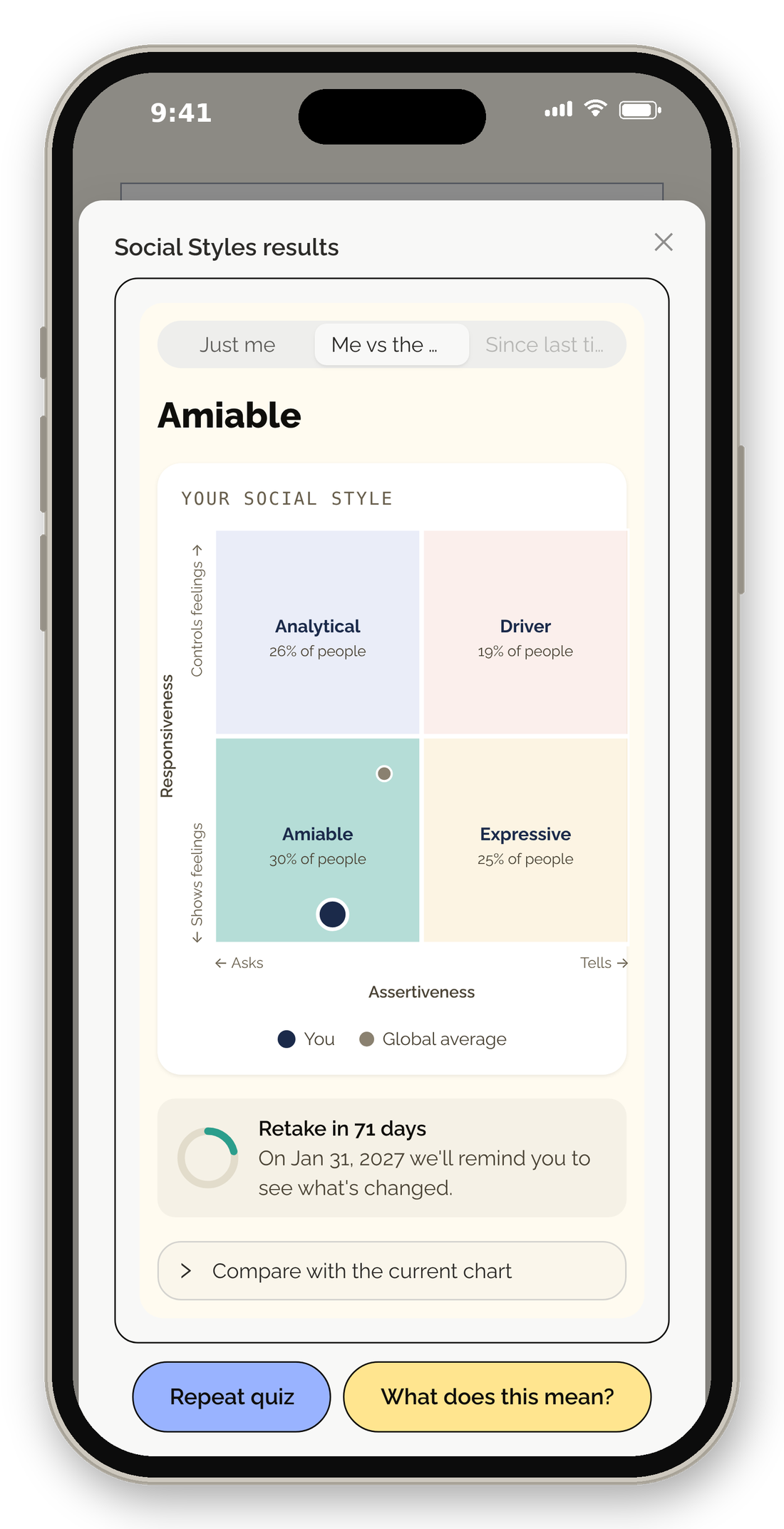
Reading a sample result
This person’s social style is Amiable. Across the bottom is assertiveness, from asking to telling. Up the side is responsiveness, from showing feelings to controlling them. Their marker sits low and to the left: they ask more than they tell, and show their feelings openly.
The Me vs the world view adds the global average, a grey dot near the center, and how common each style is: Amiable is the most common at 30 percent of people, Driver the least at 19.
The useful move for an Amiable is to recognize the Driver across the table, who wants the bottom line first, and lead with it.
The screen shows sample data from the SPARKS app.
How SPARKS goes further
A social style tells you how you come across. It cannot tell you why, or why you come across differently with a manager than with a partner. Those answers sit in other assessments.
SPARKS Relational Intelligence reads them together. Your Big Five scores explain the traits behind your outside. Your Communication Style shows what happens when the stakes rise. Your Conflict Style shows what you do once a disagreement starts. An Analytical who scores high on agreeableness withdraws into detail to avoid friction; an Analytical who scores low does it to win the argument. Same style, different cause, different fix.
Your results shape the insights in your Reflection Journal and help the Communication Coach suggest wording that fits the person you are writing to. You can compare your result with groups of people like you, never with any individual.
Questions
Social styles questions
What are the four social styles?
Driver, Expressive, Amiable and Analytical. They come from two observable scales: assertiveness (telling or asking) and responsiveness (showing or controlling emotion).
How is social styles different from a personality test?
A personality test asks how you think and feel. Social styles describes how you behave in ways other people can see. Two people with similar personalities can come across very differently.
Is one social style better at work?
No. Each style succeeds in some situations and struggles in others. Research on the model points to versatility, not any single style, as the trait linked to effective working relationships.
Why are there two versions?
Many people are more assertive at work and more accommodating at home, or the reverse. Taking both shows you where your style changes and why.
Can I use it to understand other people?
Yes. Once you know the four styles, you can recognize them in others from behavior alone: their pace, their tone, and whether they lead with the task or the person.
How long does the social styles assessment take?
Five to ten minutes for each edition.
Related assessments
- Communication Style: how your style sounds when the stakes rise
- Big Five: the traits behind how you come across
- 16 Types: your preferences, which others see as your style
From High on Healthy
Conversations on communication and connection from the High on Healthy podcast.
- Navigating Political Polarization and Historical ParallelsSocial media is an artificial setting where people say things they would never say in person, and that habit has carried into how we treat family, friends and co-workers.
- Navigating AI’s Impact on Mental Health and RelationshipsAn AI can only reflect back what you report, so if you describe yourself as emotionally available, it has no way to see what you leave out.
- Overcoming Polarization Through Meta-PerceptionsMeta-perceptions, meaning what we believe the other side thinks of us, shape hostility as much as our direct views of them do.
Sources
The Social Styles assessment in SPARKS draws on this research. See every reference.
- Merrill, D. W., and Reid, R. H. (1981). Personal Styles and Effective Performance. Chilton.
- Bolton, R., and Bolton, D. G. (1984). Social Style/Management Style: Developing Productive Work Relationships. AMACOM.
- Leary, T. (1957). Interpersonal Diagnosis of Personality. Ronald Press.
- Wiggins, J. S. (1979). A psychological taxonomy of trait-descriptive terms: The interpersonal domain. Journal of Personality and Social Psychology, 37(3), 395-412.
Your answers stay yours. No one sees your answers, and your results stay private unless you choose to share them. If your organization offers SPARKS, it sees only groups of 30 people or more, never you.