
Global · Values
What Wins: Values Trade-Off Assessment
Everyone believes in honesty, fairness and loyalty. The interesting question is what happens when two of them collide. What Wins puts your values against each other, one pair at a time, and shows you the order they actually come in.
About eight minutes. Your results appear as soon as you finish.
What Wins1:03
What What Wins measures
Give people a list of values and nearly everyone picks honesty. That tells you what people admire, not what they do. Chris Argyris and Donald Schön called this the gap between espoused theory and theory-in-use (1974): what we say guides us, and what actually does.
What Wins closes that gap with forced choices. Sixteen everyday situations each offer a choice between two good things, followed by eight short questions about what you believe. Both options in every pair are ones a good person could choose, so there is no flattering answer to reach for. Forced-choice formats are harder to answer for effect than rating scales (Christiansen, Burns and Montgomery, 2005).
Eight values are in play: honesty, loyalty, fairness, achievement, respect, freedom, responsibility and compassion, drawn from Shalom Schwartz’s research on basic human values (Schwartz, 1992). Each one meets four of the others. Your result is the order they come in when they cannot all win.
What each part of your result means
Your Anchors
The two values you act on without stopping to think.
Your order of surrender
When your values collide, what you give up first and what you hold longest. A value at the bottom of your order is a choice with reasons, and your report says what those reasons are.
Your profile
- Protector: protects the person in front of them first.
- Loyalist: protects their own people first.
- Striver: protects the goal first.
- Steward: protects the truth and the promise first.
No profile ranks above another, and no value is wrong to place last.
The honesty and loyalty question
One situation, one choice, and what that choice looks like in practice.
What your beliefs add
How you see trust, effort, change and challenge, used to sharpen the picture of your values.
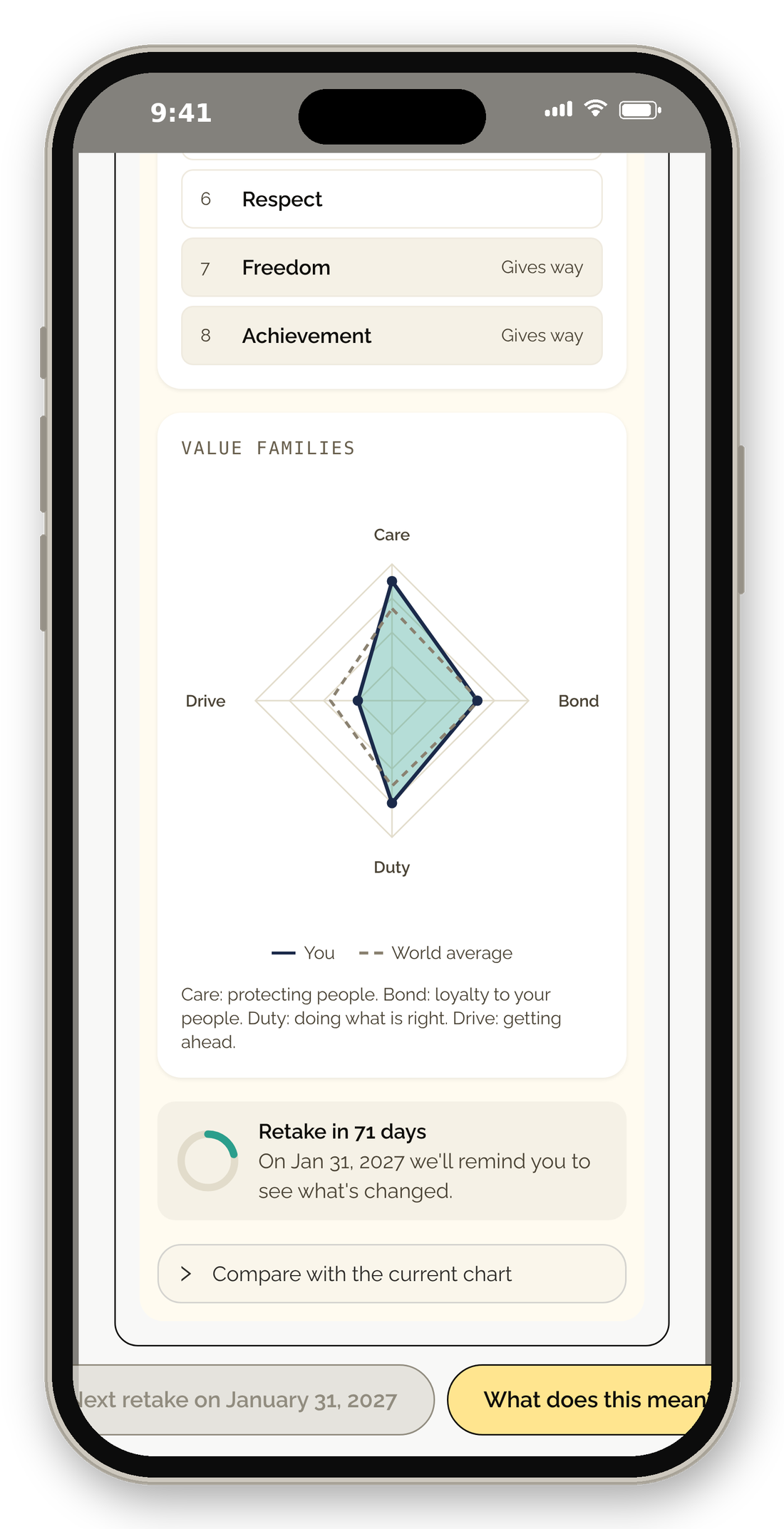
Reading a sample result
This person is a Protector. Their ladder ranks the eight values in the order they come in when they cannot all win: Honesty and Compassion at the top hold firm; Freedom and Achievement at the bottom give way first.
Value families group the same result by theme. Care is protecting people; Bond is loyalty to your people; Duty is doing what is right; Drive is getting ahead. In the Me vs the world view, the dashed line is the world average: this person leads with Care, well above average, and sits below average on Drive.
The screen shows sample data from the SPARKS app.
How SPARKS goes further
Values and Beliefs asks which values resonate with you: the ones you name. What Wins asks which ones win: the ones you act on. The distance between the two is one of the more useful things your profile can show you. If you have already taken Values and Beliefs, your belief answers carry over.
Its closest partner is True North. You may choose honesty over loyalty when the question is put to you, and still protect a friend when the moment is real. With both results in your profile, SPARKS Relational Intelligence names that gap plainly, because it is usually the most useful finding of all.
What Wins also adds depth to your leadership results and to the guidance the Communication Coach offers when a message puts two of your values at odds.
Questions
What Wins questions
Why forced choices instead of ratings?
Rate eight values and most people rate them all highly. Forced choices between two good options show the order your values come in when they cannot all win.
Is there a right answer?
No. Both options in every pair are ones a good person could choose. No profile ranks above another.
How is What Wins different from Values and Beliefs?
Values and Beliefs maps everything you hold important. What Wins forces trade-offs, so you see what you choose under pressure.
Can my employer see my result?
No. Your order of values is never shared with an organization. Where What Wins runs in a program, the organization sees only patterns across groups of 30 people or more.
How long does What Wins take?
About eight minutes: sixteen situations and eight short belief questions.
Related assessments
- True North: what holds when a friend is involved
- Values and Beliefs: everything you hold important
- The Authority Blueprint: how your values shape the way you use power
From High on Healthy
Conversations on purpose, meaning and values from the High on Healthy podcast.
- Redefining Self-Improvement and Healing with Samantha DeCaroSelf-improvement messages in our culture often focus on appearance, which is a goal no one can ever finish reaching.
- Finding Meaning and Authenticity in High AchievementBuilding a relationship with yourself takes the same things any relationship needs: time, attention, trust, and curiosity.
- Beyond the Achievement Trap: Finding Fulfillment in the Present MomentThe brain is built to predict and solve problems, so it will keep moving the bar no matter how much you achieve.
All Purpose, Meaning and Mindfulness →
Sources
The What Wins assessment in SPARKS draws on this research. See every reference.
- Argyris, C., and Schön, D. A. (1974). Theory in Practice: Increasing Professional Effectiveness. Jossey-Bass.
- Christiansen, N. D., Burns, G. N., and Montgomery, G. E. (2005). Reconsidering forced-choice item formats for applicant personality assessment. Human Performance, 18(3), 267-307.
- Schwartz, S. H. (1992). Universals in the content and structure of values: Theoretical advances and empirical tests in 20 countries. Advances in Experimental Social Psychology, 25, 1-65.
- Schwartz, S. H., Cieciuch, J., Vecchione, M., et al. (2012). Refining the theory of basic individual values. Journal of Personality and Social Psychology, 103(4), 663-688.
Your answers stay yours. No one sees your answers. Your order of values is never shared with an organization. Where What Wins runs in a program, the organization sees only patterns across groups of 30 people or more.