
Global · Integrity
True North: Integrity and Values Assessment
Everyone has a line they will not cross. Most people have never looked at exactly where it sits, what pushes it, and what holds it in place. True North maps yours. There are no right answers, and nothing here is a test of your character; it is a map of it, for you.
Four short sections, about fifteen minutes. Your results appear as soon as you finish.
True North1:02
What True North measures
True North draws on two bodies of research. The first is the honesty-humility dimension of the HEXACO model of personality: sincerity, fairness, modesty, and how strongly money and status pull at you (Ashton and Lee, 2007). It is the one trait the Big Five does not cover, and it adds to the Big Five in predicting integrity at work (Lee, Ashton and de Vries, 2005).
The second is research on moral disengagement: the stories that make a shortcut feel reasonable (Bandura et al., 1996; Moore et al., 2012). People rarely cross a line they believe in. They tell themselves a story that moves it.
Every question is a choice between set options. The situations come from everyday life: a cashier’s mistake, a group chat, a timesheet, a friend who asks a favor. No question asks about your own past conduct.
What each part of your result means
Bearing: where your line sits
Sincerity, fairness, modesty, and the pull of money and status. Your score shows how firm the line is, and which facet is least consistent.
Drift: what would move it
Twelve everyday situations, each offering the story that makes a shortcut feel acceptable: it was really teamwork, everyone does it, the rule is unfair, nobody gets hurt. You learn which story works on you.
Pull: the forces on it
Loyalty to a friend, what you believe other people actually do, whether you think the rules are applied fairly, and how much pressure you are under.
Check: a light closing round
A quick finish that keeps the rest of the map honest.
Your profile
Your report names your profile for what you do with your line, never for a failing. None ranks above another.
- The Keeper holds the line and holds others to it; the person a group trusts with the hard call.
- The Guardian keeps their own conduct clean and protects people first; the hard moment is when a friend is the one who crossed.
- The Improviser holds ordinary values with a good supply of stories, and finds the route around a rule when one is offered.
- The Free Agent treats rules as situational and trusts their own read of the situation; often effective, and hard for others to predict.
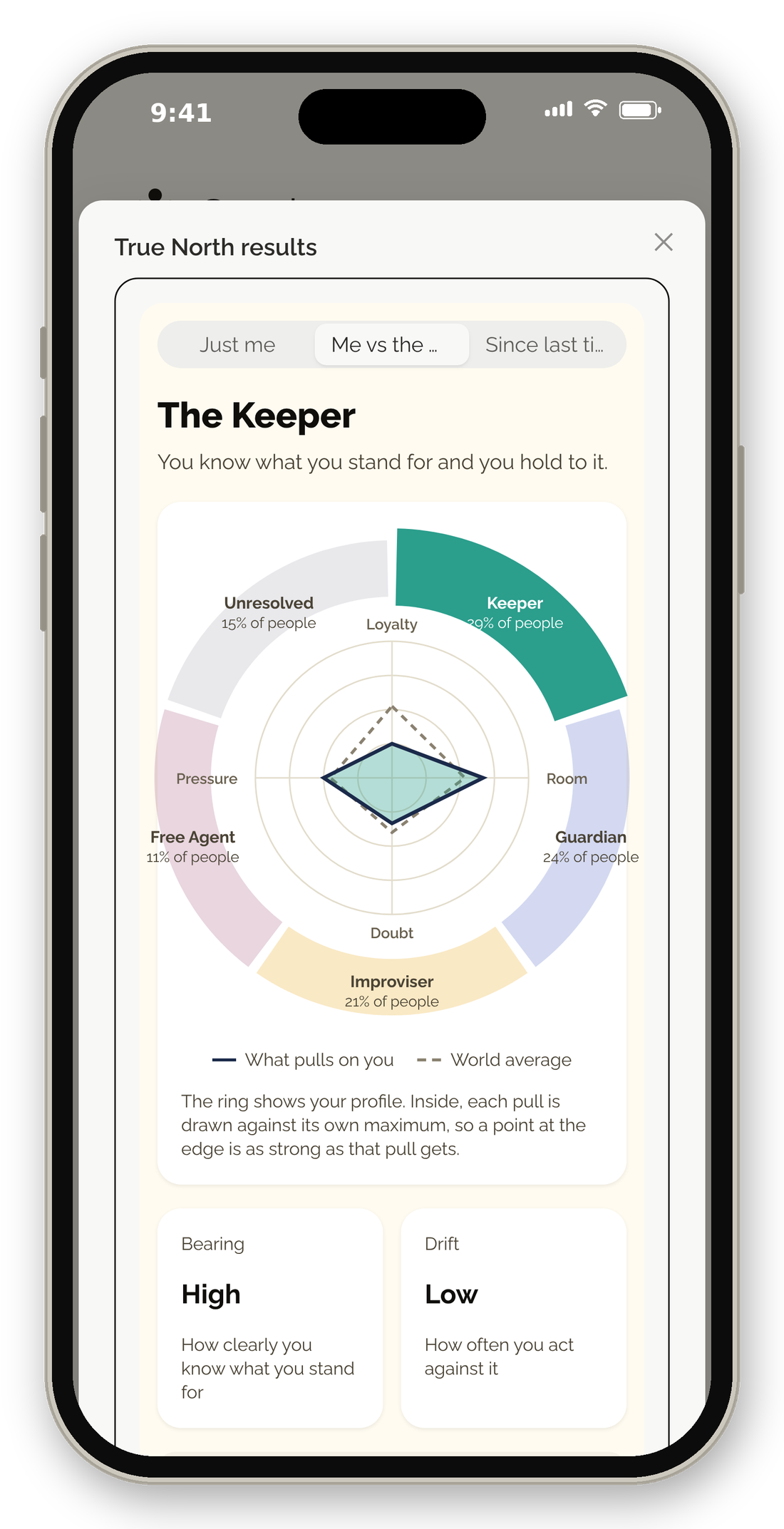
Reading a sample result
This person is a Keeper: they know what they stand for and hold to it.
The outer ring shows the profiles, with Keeper highlighted. The Me vs the world view adds how common each profile is among SPARKS users. Inside the ring, the solid shape shows what pulls on this person: loyalty, the room they are in, doubt and pressure. The dashed shape is the world average.
Below, Bearing is High, meaning they know clearly what they stand for, and Drift is Low, meaning they rarely act against it.
The screen shows sample data from the SPARKS app.
How SPARKS goes further
True North on its own shows your line. SPARKS Relational Intelligence sets it beside the rest of your profile, where the most useful findings are.
It pairs most closely with What Wins. One shows which value you say wins; the other shows what holds when a friend is involved. A gap between them is named as the most useful thing in either report. With Conflict Style, True North can show whether staying quiet comes from your values or from your conflict habits, which is the more fixable of the two. With Metacognitive Awareness, it shows whether the confidence others follow rests on solid ground.
True North sits on the Global path with the leadership set.
Questions
True North questions
Is True North an integrity test?
Not in the hiring sense. It is a private map of where your line sits and what moves it. There are no right answers and no pass mark.
What is honesty-humility?
A personality dimension in the HEXACO model covering sincerity, fairness, modesty and how strongly money and status pull at you. It is the one major trait the Big Five does not cover.
Does it ask about things I have done?
No. Every question describes an everyday situation and asks what you would do. No question asks about your own past conduct.
Can my employer see my result?
No. Your True North result cannot be released to an organization at individual level under any circumstance, including through your own sharing settings.
How long does True North take?
About fifteen minutes, in four short sections.
Related assessments
- What Wins: which value wins when two collide
- Values and Beliefs: everything you hold important
- Conflict Style: whether staying quiet is a value or a habit
From High on Healthy
Conversations on purpose, meaning and values from the High on Healthy podcast.
- Redefining Self-Improvement and Healing with Samantha DeCaroSelf-improvement messages in our culture often focus on appearance, which is a goal no one can ever finish reaching.
- Finding Meaning and Authenticity in High AchievementBuilding a relationship with yourself takes the same things any relationship needs: time, attention, trust, and curiosity.
- Beyond the Achievement Trap: Finding Fulfillment in the Present MomentThe brain is built to predict and solve problems, so it will keep moving the bar no matter how much you achieve.
All Purpose, Meaning and Mindfulness →
Sources
The True North assessment in SPARKS draws on this research. See every reference.
- Ashton, M. C., and Lee, K. (2007). Empirical, theoretical, and practical advantages of the HEXACO model of personality structure. Personality and Social Psychology Review, 11(2), 150-166.
- Lee, K., Ashton, M. C., and de Vries, R. E. (2005). Predicting workplace delinquency and integrity with the HEXACO and five-factor models of personality structure. Human Performance, 18(2), 179-197.
- Bandura, A., Barbaranelli, C., Caprara, G. V., and Pastorelli, C. (1996). Mechanisms of moral disengagement in the exercise of moral agency. Journal of Personality and Social Psychology, 71(2), 364-374.
- Moore, C., Detert, J. R., Treviño, L. K., Baker, V. L., and Mayer, D. M. (2012). Why employees do bad things: Moral disengagement and unethical organizational behavior. Personnel Psychology, 65(1), 1-48.
Your answers stay yours. No one sees your answers. Your True North result is never released to an organization at individual level, under any circumstance, including through your own sharing settings. Where it runs in a program, the organization sees only groups of 30 people or more.