
Global · Leadership
The Authority Blueprint: How Would You Use Power?
Wanting influence is not shameful; it is fuel that needs channels. Unexamined power habits are among the most expensive blind spots in working life. The Authority Blueprint shows how you use authority when you have it, and how the people around you are likely to experience it.
About five minutes. Your results appear as soon as you finish.
The Authority Blueprint1:03
What the Authority Blueprint measures
David McClelland showed that the need for power is a basic motive, and that it can be expressed in two ways: personalized, serving the holder, or socialized, serving the group (McClelland, 1975; McClelland and Burnham, 1976). His work with Richard Boyatzis linked the socialized pattern to long-term success in management (1982). Later research showed how power and status reinforce themselves (Magee and Galinsky, 2008) and when leaders choose to delegate (Leana, 1986).
The Authority Blueprint is a values assessment scoped to one sharp question: if you were handed authority, how would you use it? It measures three things:
- Power orientation: does power in your hands serve the holder (status, control, leverage) or the group (protection, enablement, mission)?
- Control style: do you concentrate decisions or distribute them?
- Rule orientation: do you treat rules as principles to uphold or tools to adapt?
The questions force choices between options that are all socially acceptable, which defeats the natural urge to give the answer that sounds best (Christiansen, Burns and Montgomery, 2005).
What each authority profile means
Each profile has a capability and a shadow side. Your report shows both, side by side.
Steward
Shares control, and uses power for the group. Stewards grow successors, and can under-claim authority the moment it is needed.
Guardian
Keeps control, and uses power for the group. Guardians protect their teams, and risk becoming the bottleneck.
Broker
Shares control, and uses power for their own position. Brokers unlock stuck networks, and should watch for loyalty becoming currency.
Sovereign
Keeps control, and uses power for their own position. Sovereigns deliver fast turnarounds, and are wisest when they choose their own checks before anyone else has to.
Rules or results
A separate scale runs from principled to pragmatic: whether you hold to the rules even when bending them would be easier, or treat them as tools to adapt.
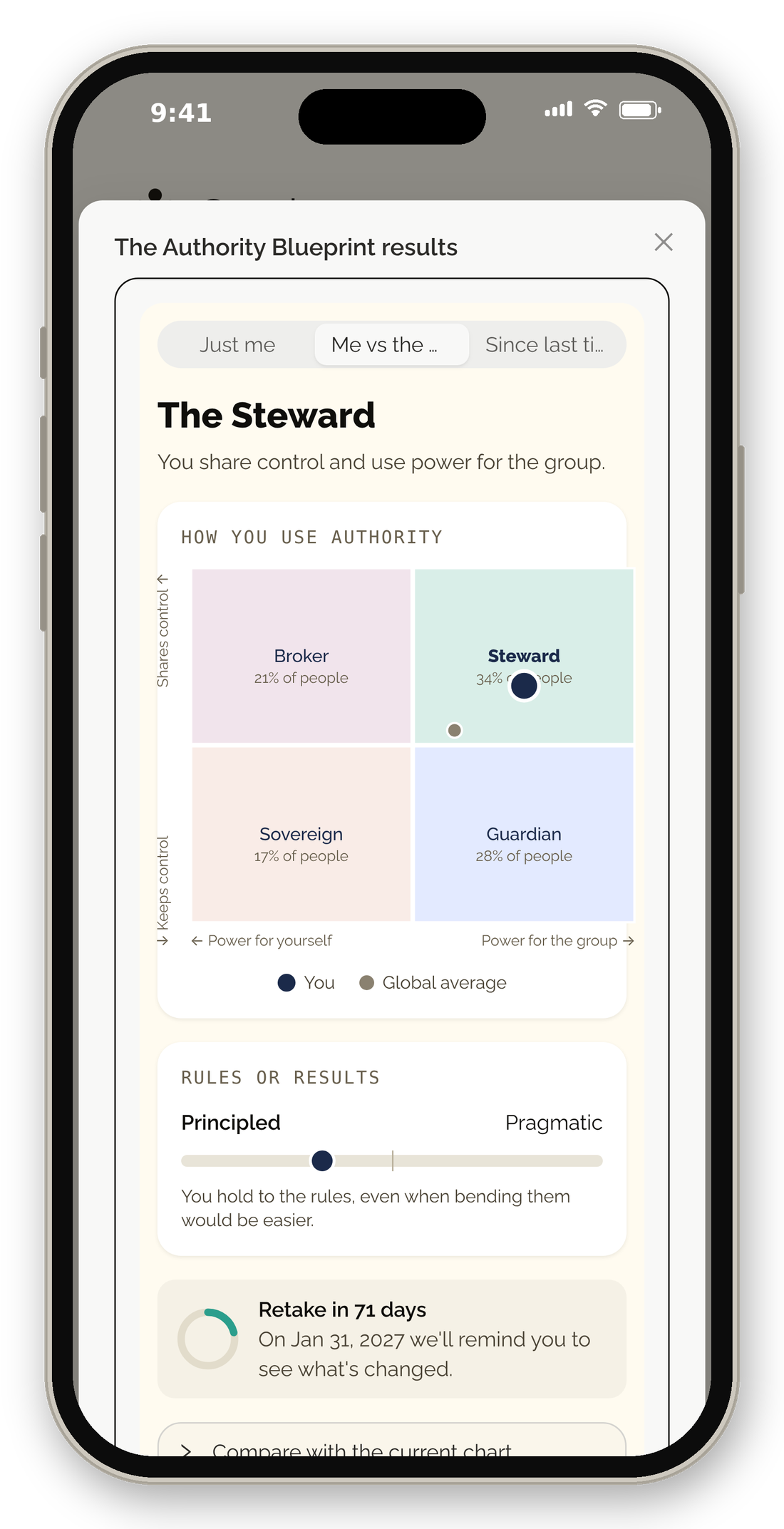
Reading a sample result
This person is a Steward: they share control and use power for the group.
Across the bottom of the map is power for yourself or power for the group; up the side, sharing control or keeping it. The Me vs the world view adds how common each profile is, with Stewards the largest group at 34 percent, and a grey dot for the global average.
The Rules or Results scale sits toward Principled: “You hold to the rules, even when bending them would be easier.”
The screen shows sample data from the SPARKS app.
How SPARKS goes further
The Authority Blueprint shows how you use power. SPARKS Relational Intelligence reads it next to the reasons behind it.
Your Values and Beliefs result sits underneath it: what you are using authority for. What Wins shows which value you protect first when two collide. Leadership Across Contexts shows where you step up in the first place. A Sovereign who steps up only in a vacuum is a crisis leader; a Sovereign who steps up everywhere is a different conversation.
You also learn how the people below and beside you likely experience your authority, stated plainly enough that you can test it against real feedback. You can compare your result with groups of people like you, never with any individual.
Questions
Authority Blueprint questions
What are the four authority profiles?
Steward, Guardian, Broker and Sovereign. They come from three measures: whether power serves you or the group, whether you concentrate or distribute decisions, and how you treat rules.
Is wanting power a bad sign?
No. Research on the power motive shows that it can serve the group as well as the holder. The question is where you channel it.
Do I need to be a manager?
No. Everyone holds some authority: on a committee, in a family, over a project.
Why are all the options acceptable?
So there is no answer that sounds best. Forced choices between good options show what you actually prioritize.
How long does it take?
About five minutes.
Related assessments
- Leadership Across Contexts: where you step up in the first place
- Values and Beliefs: what you use authority for
- What Wins: which value you protect first
From High on Healthy
Conversations on leadership and work from the High on Healthy podcast.
- Navigating AI: Trust, Critical Thinking, and Human ConnectionAI can influence you only if you use it, so the first defense is to use it with intention instead of by default.
- The Silent Crisis of Success: Nick Jonsson on Redefining Executive LonelinessLoneliness often grows at work because each step up the ladder rewards looking strong, so people hide weakness and stop asking for help.
- Unmasking High-Functioning Depression and Emotional BankruptcyLaura Ramos says high achievers are praised for doing rather than feeling, so they learn that achievement is safer than vulnerability.
Sources
The Authority Blueprint assessment in SPARKS draws on this research. See every reference.
- McClelland, D. C. (1975). Power: The Inner Experience. Irvington.
- McClelland, D. C., and Burnham, D. H. (1976). Power is the great motivator. Harvard Business Review, 54(2), 100-110.
- McClelland, D. C., and Boyatzis, R. E. (1982). Leadership motive pattern and long-term success in management. Journal of Applied Psychology, 67(6), 737-743.
- Magee, J. C., and Galinsky, A. D. (2008). Social hierarchy: The self-reinforcing nature of power and status. The Academy of Management Annals, 2(1), 351-398.
- Leana, C. R. (1986). Predictors and consequences of delegation. Academy of Management Journal, 29(4), 754-774.
Your answers stay yours. No one sees your answers, and your results stay private unless you choose to share them. If your organization offers SPARKS, it sees only groups of 30 people or more, never you.