
Personality · Values
Values Assessment: What Matters Most to You
This assessment maps what you actually hold important, and how firmly: security, achievement, autonomy, loyalty, fairness, tradition, growth, belonging and the other values that quietly decide your choices. It also shows where your values compete with one another, which is where most hard decisions live.
About five to ten minutes. Your results appear as soon as you finish.
Values and Beliefs0:51
What the values assessment measures
Values are the goals you treat as important across situations. They work as the standards you use to judge what is worth doing. Milton Rokeach set out the modern study of human values (1973). Shalom Schwartz then developed a theory of basic human values and tested it across dozens of countries (Schwartz, 1992), later refining it into a circle of related values (Schwartz et al., 2012). Christopher Peterson and Martin Seligman added a classification of character strengths and virtues (2004).
A key idea from Schwartz’s work shapes this assessment: values sit on a circle. Neighbors support each other; opposites pull against each other. Security and self-direction, or achievement and benevolence, are hard to maximize at the same time.
You see how strongly you hold each value and which ones sit close together. Just as important, you see which of your values pull in opposite directions.
What your values result means
Your strongest values
The values at the top of your result are the ones you defend without being asked. They explain why some choices feel obvious to you and baffling to others.
Values that work together
Some of your values reinforce each other. A life built around them tends to feel coherent, even when it is demanding.
Values in tension
Some of your values pull in opposite directions, such as security and autonomy, or achievement and belonging. This is where most hard decisions live. A values conflict is not indecision. It is two important things pulling at once, and seeing both is what makes the choice possible.
Beliefs
Beliefs are what you hold to be true; values are what you hold to be important. The assessment also asks what you believe about trust, effort, change and challenge, because a belief that effort is rewarded tends to support a value placed on achievement.
Reading a sample result
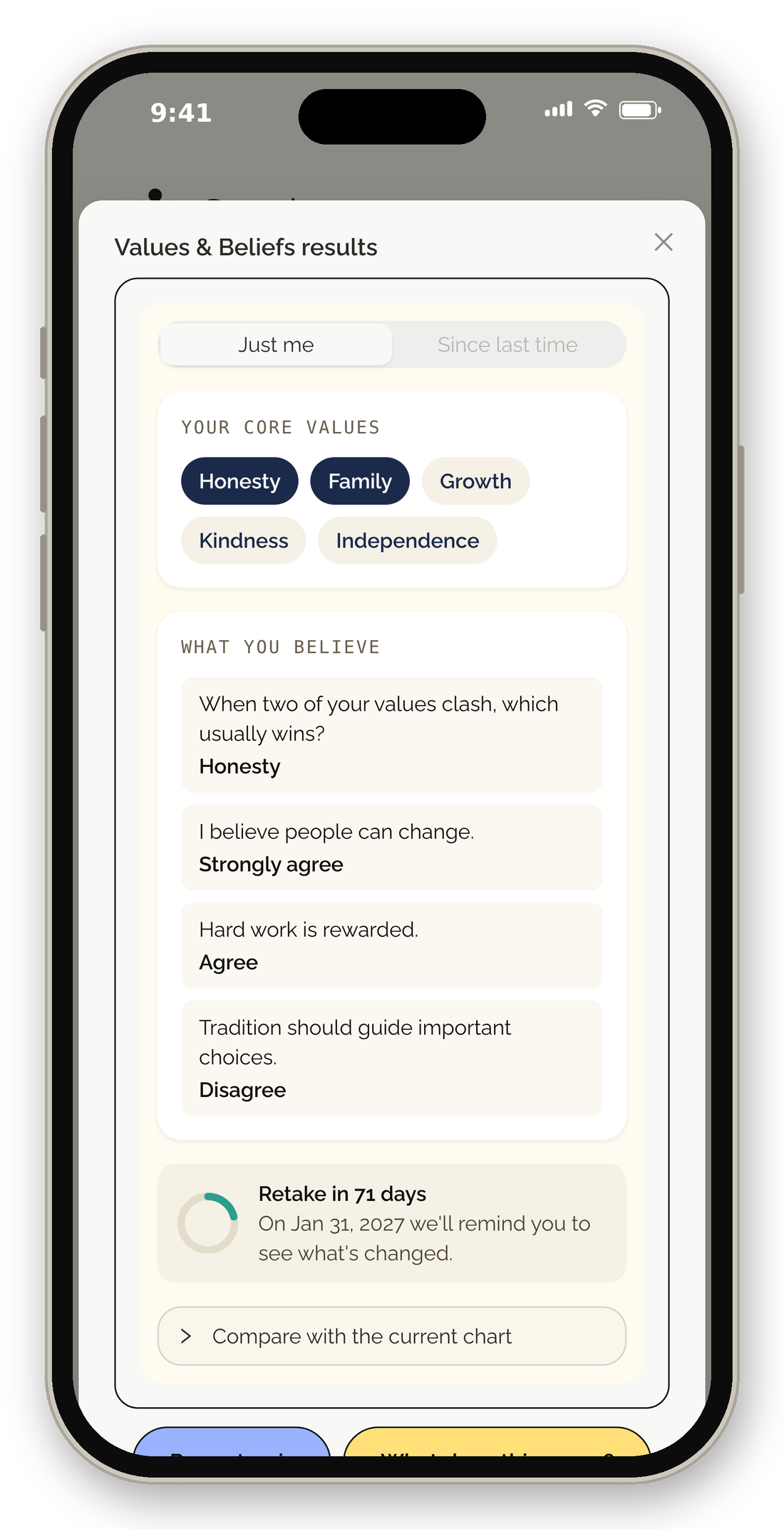
This person’s core values are Honesty, Family, Growth, Kindness and Independence. The first two are highlighted: those are the values they hold most firmly.
The beliefs underneath sharpen the picture. When two values clash, Honesty usually wins. They strongly agree that people can change, agree that hard work is rewarded, and disagree that tradition should guide important choices.
Notice the possible tension: Family and Independence both make the list. That is often where the hardest decisions sit, and it is exactly what What Wins tests. Values and Beliefs has no world comparison yet.
The screen shows sample data from the SPARKS app.
How SPARKS goes further
Where personality describes how you operate, values explain what you are operating toward. A values result on its own cannot tell you which value wins when two collide, or what holds when a friend is involved. SPARKS Relational Intelligence answers those with two companion assessments.
What Wins puts your values against each other in forced choices, so you see which one you choose when two collide. True North looks at the line you will not cross. The distance between the values you name, the ones you act on, and the line you hold is often the most useful finding in your profile.
Your values also sit underneath your Authority Blueprint when the question turns to power, and they shape nearly every recommendation in SPARKS. Values and Beliefs is one of the Core Five, with the Big Five, the Enneagram, Attachment Style and Communication Style. Complete all five and you receive your Actionable Insights Report.
Questions
Values and beliefs questions
What is the difference between values and beliefs?
Beliefs are what you hold to be true. Values are what you hold to be important. The two interact: a belief that effort is rewarded tends to support a value placed on achievement.
Can my values change over time?
Core values are fairly stable, but their order shifts with life stage and circumstance. Retaking the assessment after a major change shows what moved.
Is there a right set of values?
No. The assessment does not score values as good or bad. It shows what you prioritize so you can check whether your choices match it.
How is this different from What Wins?
Values and Beliefs maps everything you hold important. What Wins forces trade-offs between values, which shows what you choose under pressure.
How long does the values assessment take?
Five to ten minutes. You see your result as soon as you finish.
Related assessments
- What Wins: which value wins when two collide
- True North: the line you will not cross
- The Authority Blueprint: how your values shape the way you use power
From High on Healthy
Conversations on purpose, meaning and values from the High on Healthy podcast.
- Redefining Self-Improvement and Healing with Samantha DeCaroSelf-improvement messages in our culture often focus on appearance, which is a goal no one can ever finish reaching.
- Finding Meaning and Authenticity in High AchievementBuilding a relationship with yourself takes the same things any relationship needs: time, attention, trust, and curiosity.
- Beyond the Achievement Trap: Finding Fulfillment in the Present MomentThe brain is built to predict and solve problems, so it will keep moving the bar no matter how much you achieve.
All Purpose, Meaning and Mindfulness →
Sources
The Values and Beliefs assessment in SPARKS draws on this research. See every reference.
- Rokeach, M. (1973). The Nature of Human Values. Free Press.
- Schwartz, S. H. (1992). Universals in the content and structure of values: Theoretical advances and empirical tests in 20 countries. Advances in Experimental Social Psychology, 25, 1-65.
- Schwartz, S. H., Cieciuch, J., Vecchione, M., et al. (2012). Refining the theory of basic individual values. Journal of Personality and Social Psychology, 103(4), 663-688.
- Peterson, C., and Seligman, M. E. P. (2004). Character Strengths and Virtues: A Handbook and Classification. American Psychological Association and Oxford University Press.
Your answers stay yours. No one sees your answers, and your results stay private unless you choose to share them. If your organization offers SPARKS, it sees only groups of 30 people or more, never you.