
Relational Intelligence (RQ)
What Is Relational Intelligence (RQ)?
Relational intelligence, or RQ, is the capacity to operate well in the space between people. It is the skill of hearing what is being communicated beneath what is being said, holding your first interpretation loosely, and responding to what the relationship needs rather than only to the content of the moment.
By Richard Zwicky, founder of Memores Software and author of I Am the Only Normal Person in My Universe.
IQ, EQ and RQ
For decades, two kinds of intelligence have dominated how we think about people at work and at home. Both matter. Neither is sufficient on its own.
IQ: solving problems
Cognitive intelligence is analytical horsepower. It helps you reason, learn and solve problems. It says little about how you handle the person across the table.
EQ: managing emotions
Emotional intelligence is awareness of your own emotions and the emotions of others, and the ability to manage them. It focuses on the individual: what you feel, and how you regulate it.
RQ: reading and responding to the relationship
Relational intelligence focuses on what happens between two people. It asks how accurately you read the other person, how many explanations you can hold for what they did, and whether your response helps the relationship or only wins the moment.
A person can be emotionally aware and still misread a colleague, a partner or a child. RQ is the part of the picture that EQ leaves out.
Why relational intelligence matters
Nearly all of the stress that keeps people awake at night involves other people. A message that lands wrong. A conversation where both sides misread the subtext. A disagreement that restarts every week because nobody addressed what was underneath it.
At work, the cost is measurable. Research from Gallup attributes at least 70 percent of the variance in team engagement to the manager. A 2023 study by Grammarly and The Harris Poll estimated that poor communication costs US businesses about 1.2 trillion dollars a year. Those costs rarely appear as a line item. They show up in turnover, in ideas that never surface, and in meetings that end without resolution. The business case sets out the published evidence.
There is a counterintuitive risk as well. High IQ without developed RQ can make things worse. A fast mind closes the gap between observation and conclusion quickly, and in relationships that speed is often wrong. The manager who reads the room in three seconds has usually built a model of the employee rather than seeing the employee. Speed and accuracy are not the same thing.
The three capacities of relational intelligence
Relational intelligence is not a personality trait. It is a cluster of three learnable skills that work in sequence.
1. Signal detection
Every conversation carries two transmissions. The explicit content is the report, the request or the complaint. The relational subtext is the fear beneath the impatience, the need beneath the demand, the history beneath the reaction. Signal detection is the ability to hear both at once, so you answer the question that was meant, not only the one that was asked.
2. Interpretive flexibility
When someone goes quiet after a decision, the reflexive read is resistance. The real signal might be confusion about their role, a concern they do not feel safe voicing, or simply the way they process change. Interpretive flexibility is the ability to hold your first read loosely enough to consider two or three alternatives. The person who has only one explanation cannot update. The person who can hold three is the one who finds out what is actually happening.
3. Calibrated response
Two people can be in conflict about a missed deadline while the real dynamic is that one feels invisible and the other feels set up to fail. A transactional response fixes the deadline. A calibrated response addresses what the relationship needs, which is the only thing that lowers the odds of the next conflict.
Competing normals: why smart people misread each other
The person across from you in a difficult conversation is not living in chaos. They are living in a different order, one that is as real and as coherent to them as yours is to you. Most conflict is two competing normals, not one right answer and one wrong one.
Your normal is built from a handful of patterns you rarely see in yourself:
- Attachment: how you handle closeness, distance and uncertainty. See Attachment Styles.
- Personality: your default energy, attention and reaction to stress. See the Big Five and the Enneagram.
- Communication style: direct or indirect, expressive or reserved, and your mode under pressure. See Communication Style.
- Conflict style: how you balance your own needs against cooperation. See Conflict Style.
- Values: what you are operating toward, and which values collide. See Values and Beliefs.
Relational intelligence starts with knowing your own normal well enough to recognize when it is not the other person’s. That idea runs through Richard Zwicky’s book I Am the Only Normal Person in My Universe.
Signs of high and low relational intelligence
Signs of high RQ
- You ask what someone meant before deciding what they meant.
- You can name two or three explanations for behavior that annoys you.
- You notice when a conversation is about the relationship, not the topic.
- You address the impact of what happened without assigning intent.
- You repair quickly after a misunderstanding, and you can say what you got wrong.
- You adjust how you say something to the person who is listening.
Signs of low RQ
- You are often surprised that feedback did not land.
- The same disagreement returns in a new form.
- You win arguments and lose ground in the relationship.
- You reread short replies looking for hidden meaning, or you never consider that there might be one.
- People describe you as hard to read, or say they feel unheard after talking with you.
Most people show signs from both lists. RQ is not fixed, and it varies by context: many people read colleagues well and partners poorly, or the reverse.
How to improve your relational intelligence
Relational intelligence improves with practice, the same way any skill does. Five habits make the biggest difference.
Know your defaults
You cannot adjust a pattern you have never seen. Understanding your attachment, communication and conflict styles tells you where your first read is most likely to be wrong.
Slow the first interpretation
When a message or a reaction bothers you, write down your first explanation, then two others. The goal is not to be right. It is to stay open long enough to find out.
Listen for the second channel
Ask yourself what the person needs, not only what they said. Questions such as “what would help most right now?” surface the subtext without forcing it.
Name impact, not intent
“When the deadline moved, I was left without time to prepare” opens a conversation. “You set me up” closes one. Describing impact keeps the other person able to listen.
Repair after a break
Every relationship has ruptures. What predicts its strength is how quickly and honestly the break is repaired. A short, specific acknowledgment does more than a long defense.
Relational intelligence at work
When organizations hire for cognitive ability and assume relational skill will follow, people solve problems well and relate to each other poorly. The work gets done; the cost is hidden in turnover and in conflict that never resolves.
Teams that work well over time build structures for relational accuracy: feedback norms that address impact rather than intent, meetings that leave room for the slower processor, and conflict practices that treat disagreement as competing normals to understand, not a contest to win.
For organizations, SPARKS reports stress and strain at cohort level, never for individuals, so leaders can see where pressure is building months before anyone resigns. See how it works for organizations.
How Sparks helps you build RQ
Sparks starts with short, research-based assessments that map your relational defaults. Together they form your Prism, a single picture of how you think, relate and respond under stress.
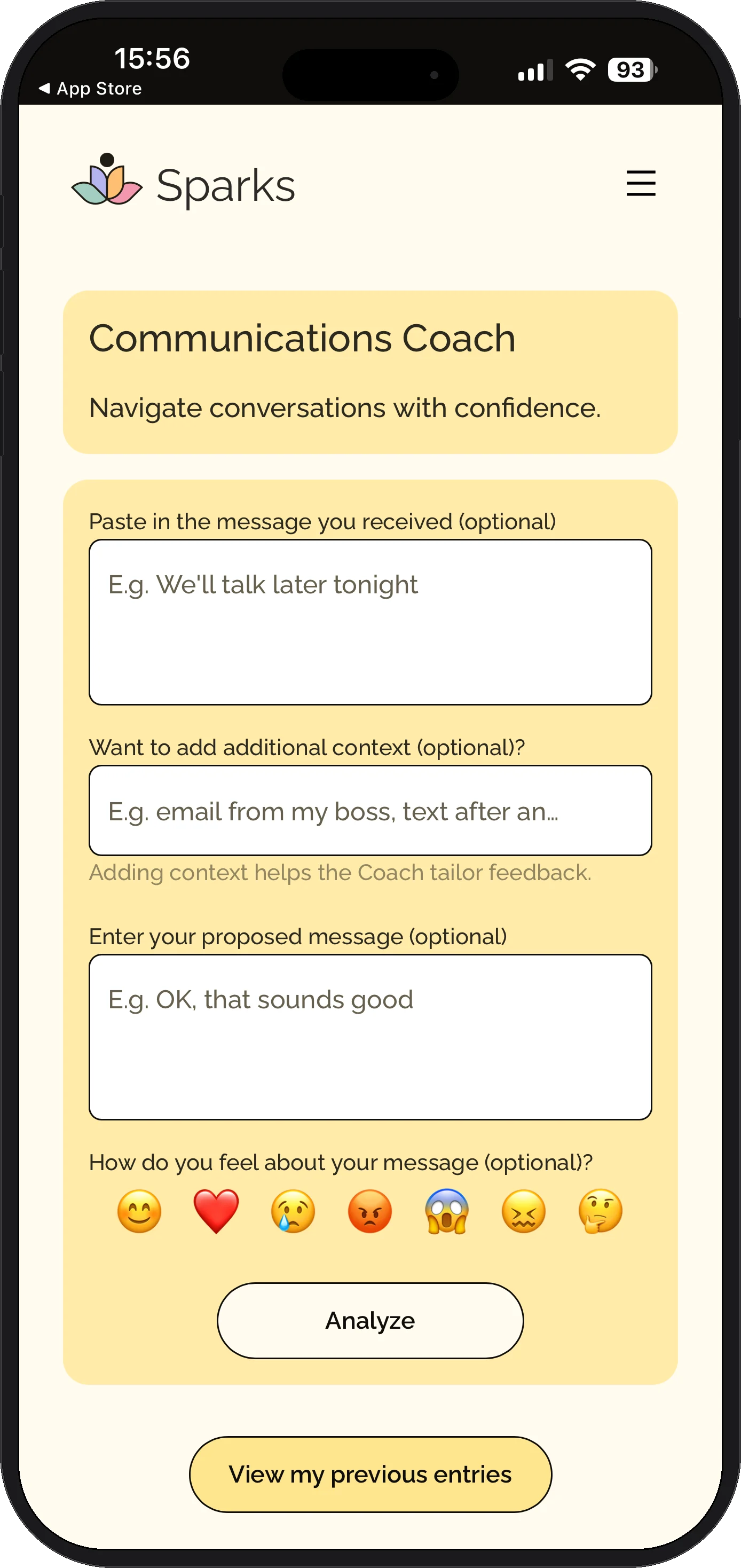
That profile shapes two everyday tools. The Communication Coach works in Gmail, Outlook and on your phone keyboard. It helps you read what a message likely means and word your reply so it lands the way you intend. The Reflection Journal helps you look at a difficult interaction from more than one side.
Your results are private. If your organization offers Sparks, it never sees your answers. Finding Your Prism explains where to start.
Questions
Relational intelligence questions
What does RQ stand for?
RQ stands for relational intelligence, sometimes called relational quotient. It sits alongside IQ, cognitive intelligence, and EQ, emotional intelligence.
Is relational intelligence the same as emotional intelligence?
No. Emotional intelligence focuses on understanding and managing emotions, mostly your own. Relational intelligence focuses on what happens between people: how accurately you read someone, how flexibly you interpret them, and how well your response serves the relationship.
Is relational intelligence a personality trait?
No. It is a set of learnable skills: signal detection, interpretive flexibility and calibrated response. Personality shapes your starting point, but the skills improve with practice.
How do you measure relational intelligence?
There is no single validated RQ test. Relational intelligence is best understood through the patterns that drive it, such as attachment, communication style, conflict style and values, each of which has established research behind it.
Can relational intelligence be learned?
Yes. Knowing your defaults, slowing your first interpretation, listening for subtext, naming impact rather than intent, and repairing quickly after a break all build RQ over time.
Why does relational intelligence matter at work?
Most workplace friction is relational: feedback that does not land, conflict that keeps returning, and talented people who leave. Research attributes most of the variance in team engagement to the manager, which makes relational skill one of the highest-leverage abilities a leader can build.